

By Maitreyee Boruah
A conflict-torn region of Assam is experimenting with a new way of raising awareness on mental health impacts of domestic violence: using survivors as community workers in villages.
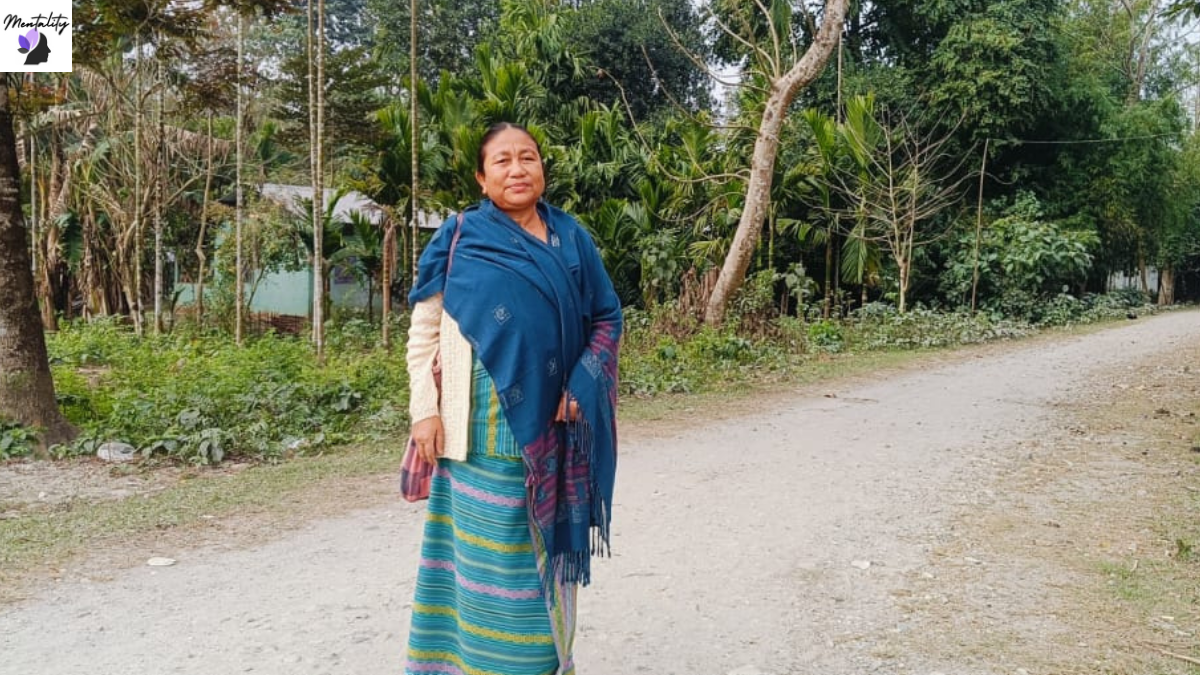
Damayanti Brahma is a friend, philosopher, and guide to almost all the women of Sonapur, a village in Chirang district, about 170 kilometres north west Guwahati, the major city in the region. “See, we are all sisters,” she said. She spends her days talking to the women of about 12 villages about domestic violence and the impact that has on the community’s mental health.
“Domestic violence is common in these villages,” she said.
Chirang is a part of the Bodo Territorial Region, a relatively isolated area, which has seen armed conflicts over autonomy and secessionist movements for about four decades. In 2020, an autonomous administrative unit of the state was established comprising four districts.
This conflict has inflicted trauma on several generations, said Mintumoni Sarma, a public health consultant from the region. Such trauma coupled with economic stagnation and unemployment plays out in complex ways. One of them is domestic violence, which has broken up countless families, said Brahma looking back at her 15 years of experience of counselling.
According to the National Family Health Survey (NHFS-5), nearly 33% of ever-married women in Assam have experienced spousal violence.
“Assam occupies the top place among all the states consecutively since 2018 as per the report of the National Crime Records Bureau under the broad head of ‘crime against women’,” according to a 2024 study by researchers at Guwahati’s Cotton University, “while section 498A has the highest share under this broad category.”
Section 498A of the former Indian Penal Code refers to cruelty against women, including dowry harassment, by the husband or his relative.
Therefore, addressing the mental health impacts of domestic violence is an urgent need in the state.
Although Assam has one of three central mental health institutions in the country, in Tezpur, there is a severe lack in extending effective mental health services to remote districts like Chirang.
Personal and political
Brahma’s experience with domestic violence is not limited to her years as a counsellor.
She was only 16 years old when she was married off to a local businessman. “He beat me, sometimes leaving injuries in my arms and legs,” she said. Her husband died of natural causes 14 years ago.
But talking about domestic violence brought a lot of shame to women. Even as they suffered physical pain, they didn’t have the language or awareness to process its mental health impacts. “Both mental health and domestic violence are still taboo subjects,” she said.
Women like Brahma are best suited to take mental healthcare to remote villages, Sarma said. “They are from the community and have a shared trauma.”
47-year-old Brahma walks five kilometres from her village of Goybari to Sonapur a few times a week, beating extreme heat or in chilly winters. The villagers of Sonapur are Bodos, just as Brahma. “It took me years to build trust among the communities by regularly visiting and talking to them,” she said.
When Brahma started sharing her story with the women, she made significant breakthroughs.

Collective care
For years, 35-year-old Hemola Basumatary, a resident of Sonapur, suffered an abusive marriage. “Every time my husband would beat me, I would not sleep or eat for days,” she said.
For the past few years, Basumatary has been speaking to Brahma regularly. “ I was hesitant to speak about my trauma,” she said, but opened up because of Brahma’s story. She said she is in a better place now.
There is evidence that primary care within family and community is effective, said Sarma. “Our only fear is whether there is suicidality (those who are at risk of suicide, usually indicated by suicidal ideation or intent),” he added.
In that case, community workers are asked to monitor the person and bring them for treatment to hospitals. People with severe mental health issues, like psychosis or schizophrenia, get treated by mental health professionals.
Involving men
Twenty years ago, Hasina Khatun, 39, began speaking to communities in Chirang about dealing with the mental health impacts of domestic violence.
Khatun and Brahma were trained by a local NGO working on intimate partner violence. “During the initial period, we do hand-holding,” said Nijira Narzary, lead, The Ant’s Avahan project, which has trained about 100 women like Khatun.

Over a period of time, the woman noticed that focusing on the men would go a long way in dissipating the problem. “When we began addressing men’s stress and anger,” said Khatun, “we saw a reduction in domestic violence cases.”
In the villages that Khatun often visits, she organises group discussions where everyone is encouraged to speak freely. “There are no judgments,” she said.
Basumatary said Brahma’s counselling has helped her husband too. “He has stopped beating me,” she said. Even though doesn’t have to endure physical violence at home anymore, she has a different worry: her husband has no income and refuses to go to work. Counselling has not helped with everything.
But, for Brahma, that is a small victory. “The men who beat their wives and children also suffer from mental health issues,” she said.
Basumatary is now forced to earn for the family and send her 12-year-old son to school; she earns Rs 300 a day as a farm labourer.

Ruhul Amin, a researcher from Assam’s Barpeta district, has conducted a study on the mental health of women in rural areas of the state. He said the state might benefit from replicating the Chirang model in other regions.
Brahma has been counselling Padmashri Brahma (no relation), 30, from nearby Palashguri village for about a year now. “Sometimes I feel like leaving my husband,” she said.
For women in these areas, distancing themselves from their husbands would only provide temporary relief. The invisible mental trauma, however, stays on for a long time.

Author: Maitreyee Boruah
Maitreyee Boruah is an independent journalist who reports from Assam and Karnataka.