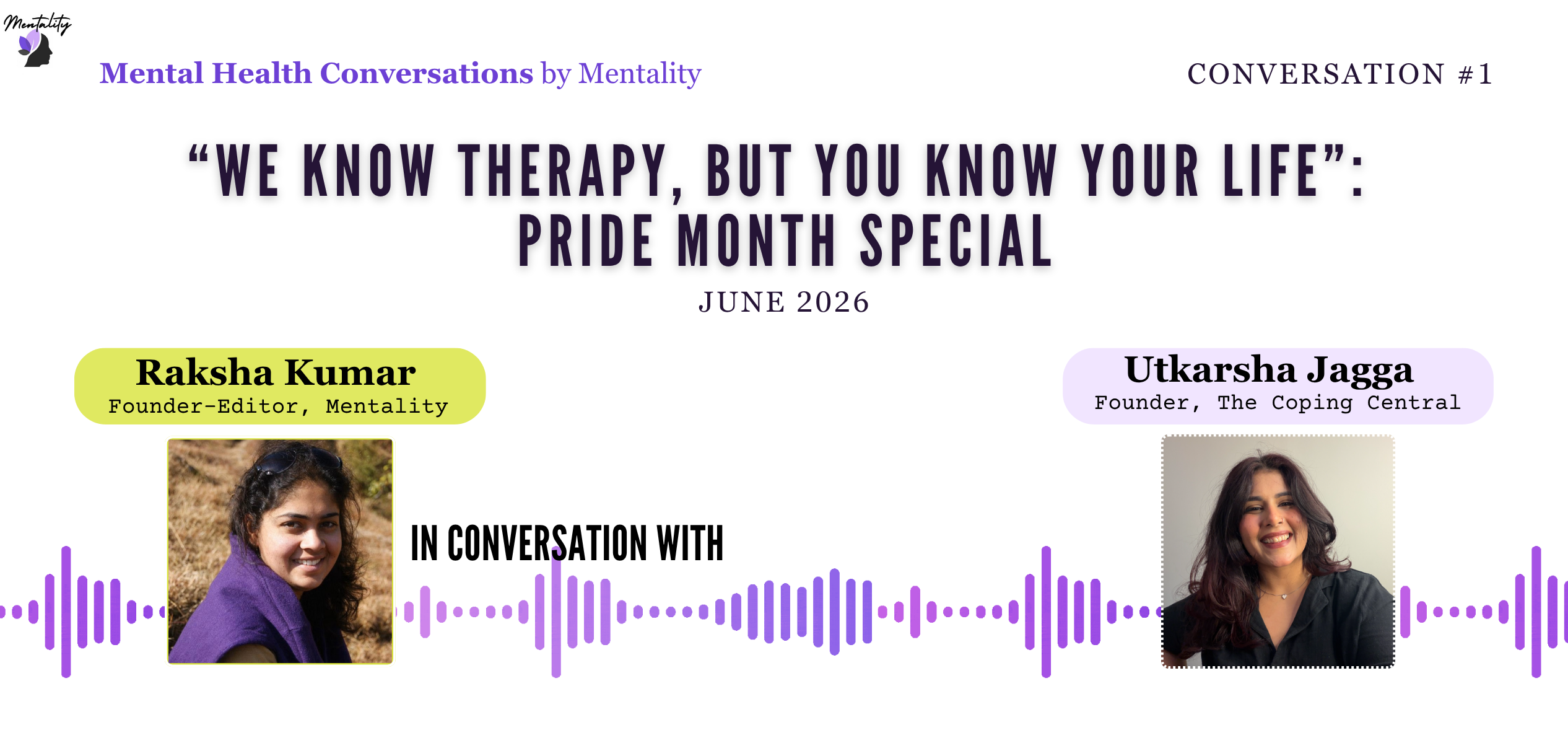
Mentality’s editor Raksha Kumar and mental health practitioner Utkarsha Jagga dive into how queerness informs therapeutic care and practice, the limited queer-affirmative mental health training in India, and how increasingly oppressive policies risk queer people’s basic safety and access.
Utkarsha Jagga is a counselling psychologist and the founder of Delhi-based The Coping Central. Her therapeutic practice is queer-affirmative, trauma-informed and driven by the principles of narrative therapy and social justice. In this conversation, she shared what it feels like to be on both sides of the therapy room – as a practitioner and a client. Training to be a counsellor Speaking of her own experience as a queer-affirmative therapist, Jagga discussed the continued process of learning and unlearning, knowing that the intersectional gender, class, caste, and sexual identities of each client call for a unique understanding of their personal life factors and the larger political climate. The question, she said, becomes whether the mental health practitioner wants to evolve or wait for their client to fit the mould. The limited number of institutions in India providing informed and quality queer-affirmative therapy training further widens the gap between therapists and queer clients. Jagga pointed out that while the idea of therapy in curricula and training spaces remains very cisgendered, White and heterosexual, therapeutic practice in a country as diverse and intersectional as India looks different.
Queer person in a therapy room
The conversation also addressed how, even before stepping into the therapy room, queer people face hurdles that do not cross the minds of cisgender and heterosexual clients, such as the risk of coming out to their therapist and whether concerns related to their identity will be understood. Jagga said she would like to direct the focus of the therapy room from personal maladaptations to the systemic forces and policies which threaten the physical safety, access to employment and other citizenship rights of queer people. For queer people, she noted, a large proportion of resources and energy is spent on ensuring basic safety and well-being, leaving little focus on growth and joy.
The conversation also addressed how the power dynamic between a therapist and client is altered when one person belongs to a marginalised community, the tendency to reduce queer people to solely their identity markers, and how visibility and affirmation in and beyond the therapy room can be significant sources of mental wellness.
Watch the whole conversation here: