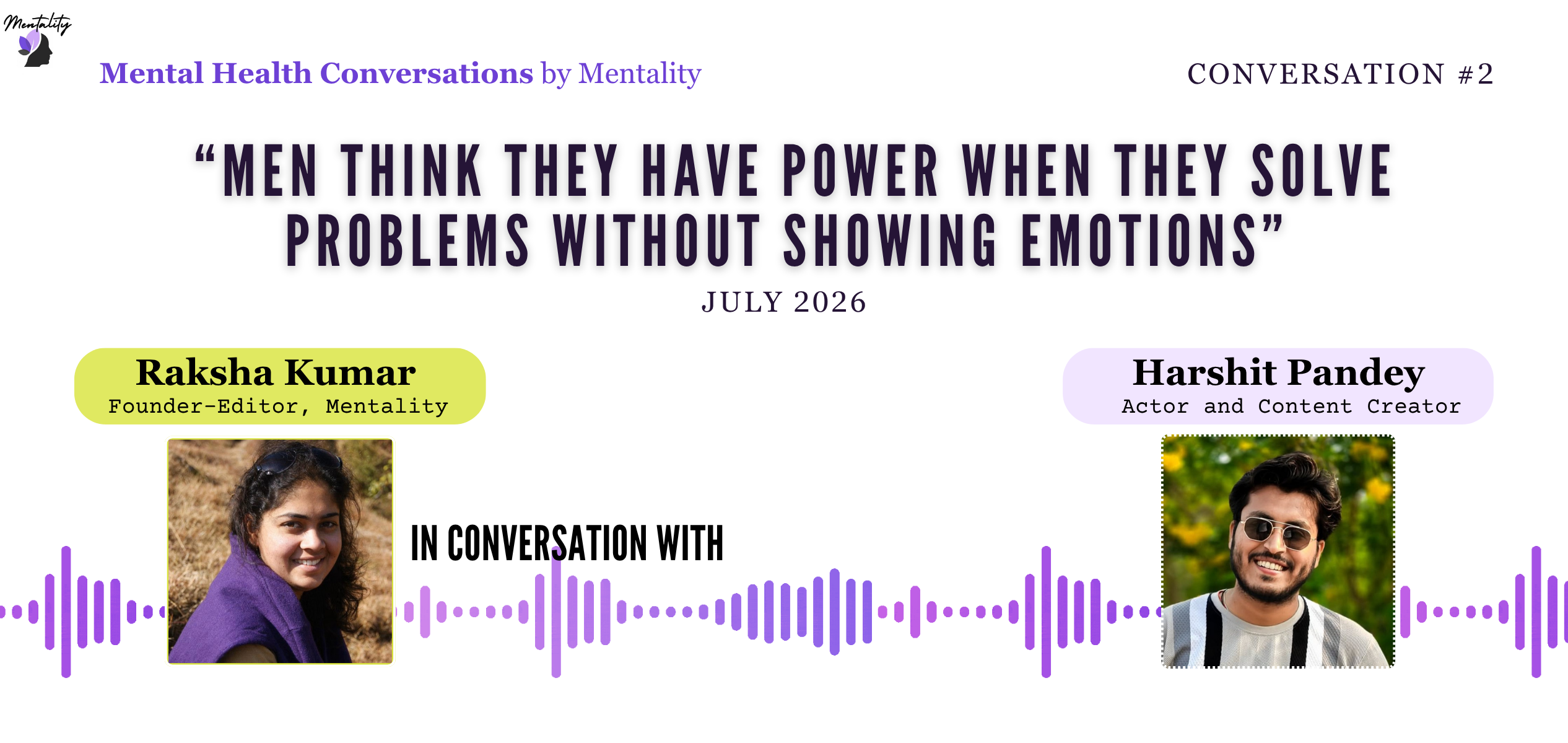
Mentality’s editor Raksha Kumar and content creator Harshit Pandey discussed the unique challenges of addressing men’s mental well-being on the occasion of Men’s Mental Health Awareness Month.
Harshit Pandey is a comedy and fashion influencer who is a part of CEQUIN’s ‘Mardon Wali Baat’ campaign. The campaign aims to sensitise men, especially young boys, about gender stereotypes and equality across all genders. His work during the campaign also tackles how to foster respect, consent and trust between men and women.
From misogyny to sensitivity
As a public figure, his experience of talking about men’s mental health online has been marked by a radical change in his own worldview and laying the seeds of a similar shift for his followers. He shared his journey from having no outlet to share his emotions within the stereotypical bounds of masculinity to realising the importance of personal relationships for coping with life’s challenges and societal expectations of men.
On the flip side, he is often met with backlash for challenging gendered expectations while addressing men’s struggles to speak about their mental health. He has found his content being removed from social media and his YouTube channel being taken down entirely.
Pandey took us through his journey from an actor to a content creator and now a driver of conversations about redefining masculinity and men’s mental health. He spoke of the cultural expectation for men to suppress their emotions, equate suffering in silence with strength, and the unaddressed mental and physical distress caused by ignoring these emotions.
Yet, he continues to address the impact of generations of men being told that acknowledging and sharing their mental health struggles makes them “weak.” He noted through his observations that men’s suppression of their emotions often leads to pent-up frustration, disproportionate emotional reactions to situations, and personal relationships lacking the depth and acceptance that tend to be allowed among women.
The “Tradwife” question
The conversation steered to the rise of the ‘tradwife’ movement on social media and figures like Andrew Tate who call for a reinstatement of traditional gender roles, rooted in hypermasculinity and a subsequent subjugation of women.
Pandey said that the visibility of such content online calls for a greater responsibility of the public to stand for equality and accountability. While it might not be possible to halt the production of such content, he said, it is important to call out its influence in one’s immediate surroundings.
He also dissected the rise of the ‘manosphere’ and “high testosterone” films in India, thinking of masculinity beyond societal expectations and the need to establish networks of support among one’s friends and family, especially for men. They probed into questions of different generations’ acceptance of mental health concerns and of navigating uncertainty, society’s ideal of masculinity and its consequences on individual lives.
Watch the whole conversation here: