
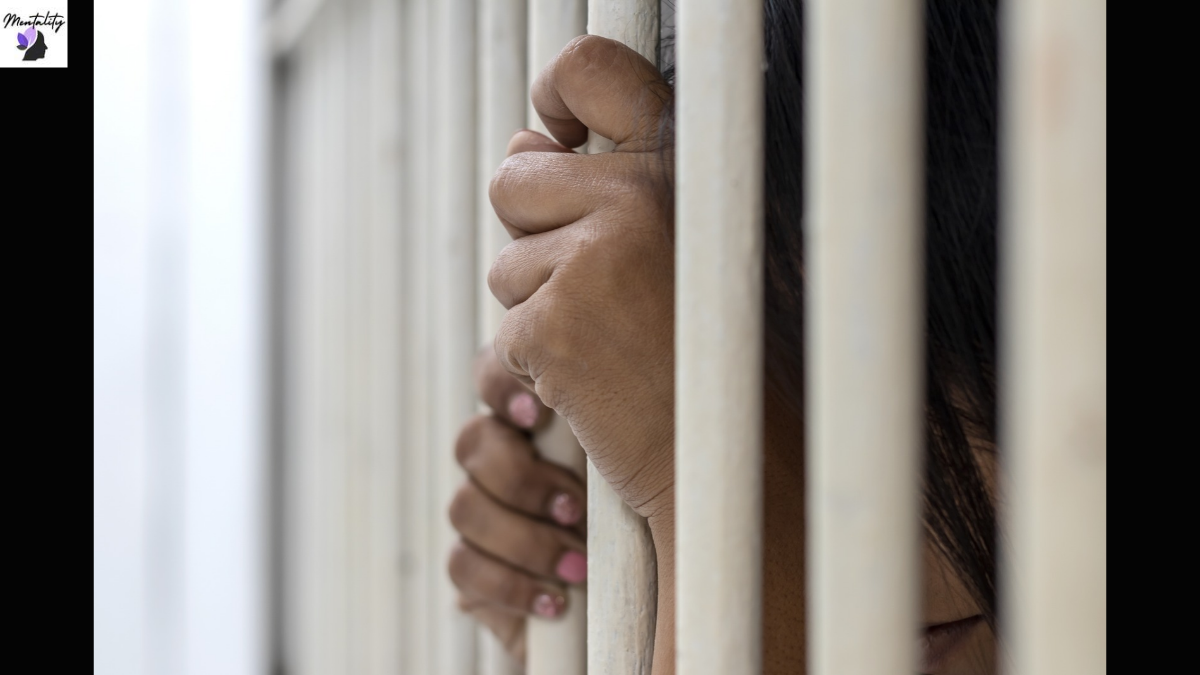
Representative image of a woman behind bars (Image Credit: Ahmad Juliyantao/Vecteezy)
By Vijay Raghavan, Saugata Hazra, and Vidya Torane
The image of a police officer as fearless and emotionally strong is deeply ingrained. That leaves very little space to acknowledge vulnerability, even when someone is struggling. Mental health support should become a part of the policing system itself, just like training, welfare, and discipline.
In 2019, KT, a woman in her mid-thirties was taken into custody in a case of kidnapping a child from a railway station in Mumbai. She was a patient of schizophrenia. The whereabouts of her family members were not known.
After a Fellow at Prayas intervened, KT was provided regular medication for her mental condition between November 2019 and June 2021. She did not show any signs of concerning behaviour.
At Prayas, a field action project of the Centre for Criminology and Justice, Tata Institute of Social Sciences, one of our aims is to change policies around custodial/institutional rights and rehabilitation of socio-economically vulnerable individuals and groups who come into direct contact with the Indian criminal justice system. We place social work students and fellows to work in prisons across Mumbai.
The Prayas Legal Fellow assisted in the process of KT’s release through the appointment and intervention of an empanelled free legal aid lawyer, appointed through the District Legal Services Authority. As KT was not able to arrange for cash security of INR 15000/- as was directed by the court, an NGO provided the cash bail amount, and she was released from prison in June 2021.
But KT started behaving erratically after her release. She assaulted a Prayas staff member while being escorted to a shelter home. At the shelter, she started removing her clothes inappropriately. Rehabilitation workers from Prayas took her to court for admission to a mental healthcare institution for assessment.
Her story clearly indicates that prisoners with special needs—for example, women, persons with disability, elderly prisoners, and persons with mental or emotional problems—do not get the attention and care that they need during or after the incarceration period.
Women prisoners have it worse
After working in this field for over three decades, we feel that there are some basic policy interventions that would not just help people like KT but also provide an enabling environment to ensure socio-legal support required to access justice and fair trial processes.
Scholarship on the psychological impact of prisons on its inhabitants highlights loss of autonomy, need for psychiatric evaluation, and indefinite periods of incarceration, amongst others, to be pivotal factors to the psychological well-being of a prisoner.
Studies show that gender-specific challenges particularly aggravate the plight of women prisoners in Indian prisons. Commonality in behavioural aspects in stories leading up to commission of crimes indicate their elevated levels of anxiety due to familial discord, separation from children, history of physical and sexual violence, and fear and shock over mistreatment during police or judicial custody as some of the important factors that tend to take a toll on a woman’s mental health.
A 2021 study by Navdeep Kaur and Sanjoy Roy from the Mandoli Prison in North East Delhi show that around 73% of the women suffer from depression, and 78% suffer from anxiety, while 82% suffer from somatisation, that is physical symptoms caused by biological, social, or psychological factors.
Rehabilitating a destitute woman prisoner
Thirty-eight-year-old RBS, a mother of four children, was alleged to have attempted to traffic one of her own children in late 2024. The Prayas Social Work Fellow, during her initial visits, found that RBS apparently resided on a railway platform in Mumbai. She had four children who were placed in protective custody pending investigation and trial. Her husband is alleged to have initially deserted her for another woman. However, he subsequently began visiting RBS in prison and made amends with her. As per observations of the Fellow and medical records from prison, she was engaged in self-talk, often behaved rudely with prison staff, and behaved violently by trying to strangulate fellow prisoners. She had episodes of seizures in prison according to prison authorities. Interventions were initiated by the social worker to ensure that medication was administered to her. After her release, Prayas social workers noticed some potential issues in relation to her intellectual disability. Her episodes of seizures coupled with behavioral issues required that a wide range of evaluation ranging from neurological disorders such as epilepsy, to many forms of intellectual disabilities be conducted urgently.
Policy Recommendations
Given our extensive work in the space, we want to recommend a multi-disciplinary team providing holistic services to ameliorate the challenges faced by women with cognitive and psychosocial challenges.
A screening process needs to be introduced for prisoners showing signs of mental health and/or cognitive challenges at the time of admission to prison.
Interventions of nominated representatives and local level committees have to be introduced as part of interventions for incarcerated persons, especially in the case of women, who suffer from lack of family support and increased levels of social stigma.
A partnership between the state and civil society actors can become a part of the policy framework to strengthen responses to address issues of mental health and intellectual disability among incarcerated populations.
Under the Rights of Persons with Disabilities Act, 2016 (RPWD), both mental illness and intellectual disability fall within the ambit of persons with benchmark disabilities. However, there is a desperate lack of correctional programmes and post-release rehabilitation services for prisoners.
We wish to raise these issues, hoping for some drastic changes to the way we treat our prison populations, especially women.
After her treatment at the mental healthcare institution, KT currently lives on her own. Her case has still not concluded though, and she is attending court regularly.

Author: Vijay Raghavan
Vijay Raghavan is a professor at the Centre for Criminology and Justice, School of Social Work, TISS and leads Prayas, a field action project of TISS working in the criminal justice system on the legal rights and rehabilitation of persons coming in contact with the CJS.

Author: Saugata Hazra
Saugata Hazra is a practicing advocate and law researcher. He was a Senior Legal Fellow with Prayas till recently.

Author: Vidya Torane
Vidya Torane is a social worker who was with Prayas a Senior Social Work Fellow till recently.