
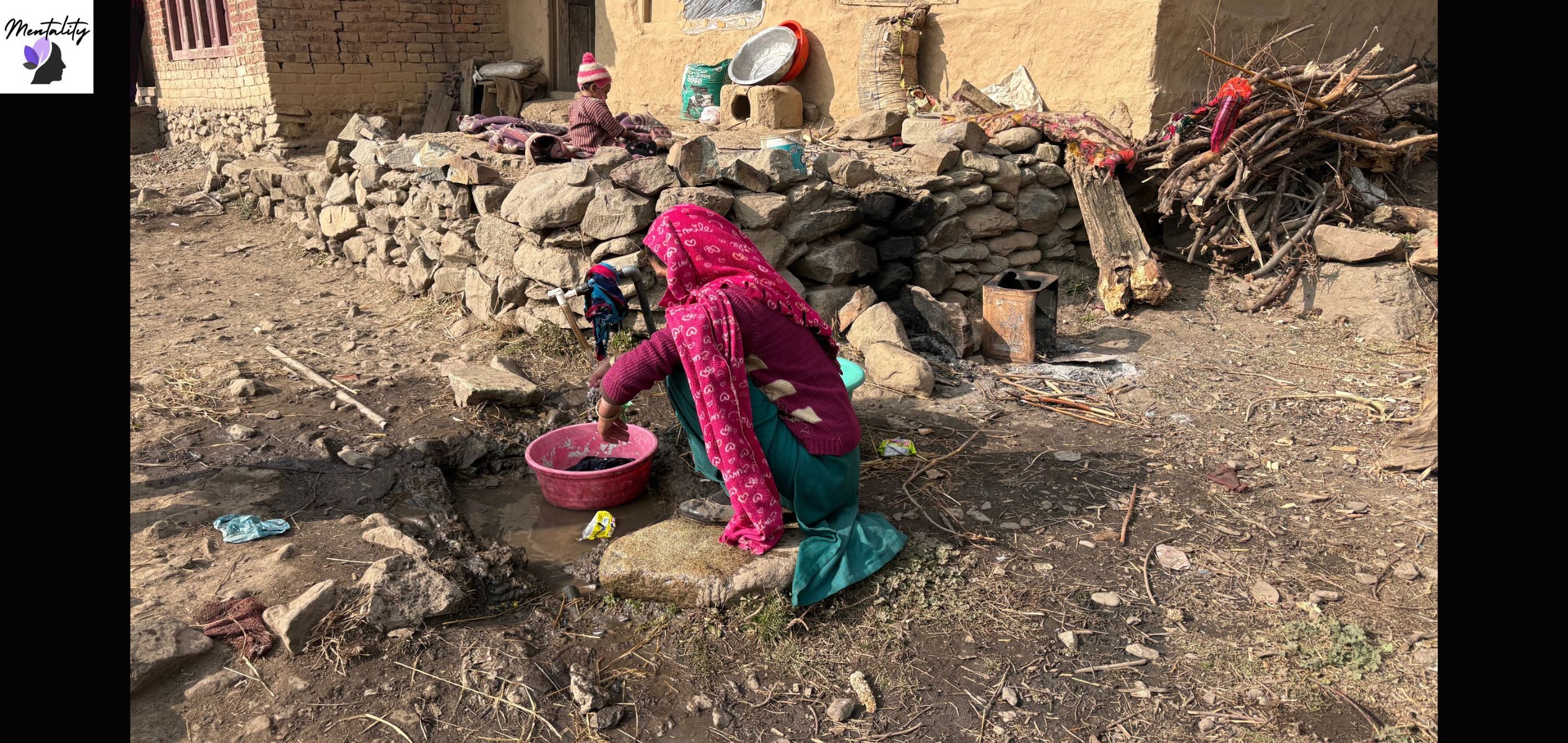
Reshma Begum washes clothes outside the house in this bone chilling winter. (Image Credit: Baseera Rafiqi)
By Baseera Rafiqi
Although research has pointed to high rates of stressors in the community, few among the Gujjar Bakarwals access mental health care. People usually approach a professional at a late stage when symptoms become severe or disruptive, and the patient shows aggressive behaviour or acute social isolation.
Sixty-five-year-old Parveena Begum has always found it tough to keep up with the multiple changes to her life and livelihood. “I got married, had children, and now grandchildren,” she said. However, those are not the changes that stress her out.
Begum was born into a Gujjar family, in Kashmir, at a time when most of her community would traverse the Himalayas in Kashmir and Ladakh during the summers and the plains and Peer-Panjal ranges of the Jammu region during the winters. The nomadic lifestyle defined their food habits, habitats and shaped their identities.
Gujjar-Bakarwals, classified as scheduled tribes, are nomadic communities who form about 15% of Jammu and Kashmir’s population.
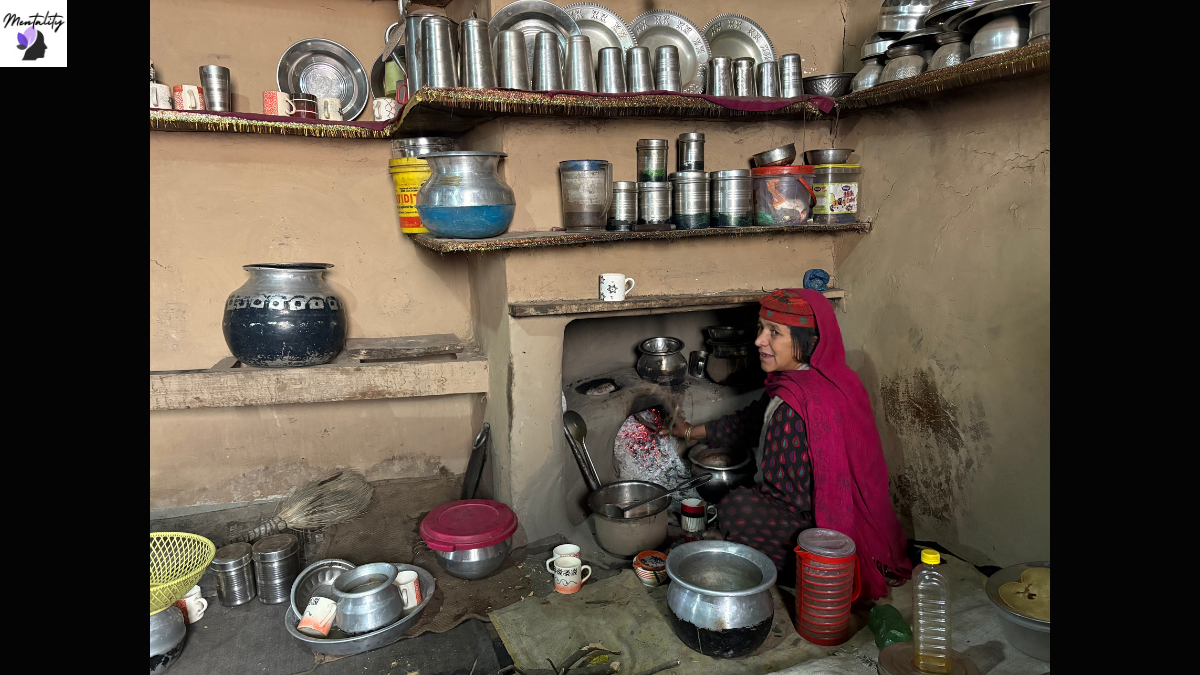
Begum grew up among goats, sheep, buffaloes, horses, and mules, since her family were pastoralists who survived by rearing livestock.
Over the years, livestock rearing began contributing less and less to a family’s income owing to lack of access to pastures, urbanisation, road construction, and climate change. This meant that Begum, her husband, and five sons were forced to look for jobs. Being unskilled and having little access to vocational training made them unattractive in the job market. “The sources of livelihood available to tribal communities cannot match the demands of modern markets, creating a constant imbalance and stress,” said Dr Javaid Rahi, researcher and a tribal activist, who has studied the communities closely.
Moving with livestock
Gradually, many in Begum’s community began settling down near small and big cities so they could access education, healthcare and other benefits. Begum now lives in Dodamarg in the Tral region of Pulwama district, about 30 kilometres south of the capital, Srinagar.
However, her family still migrates with their livestock to upper forest regions near Sonamarg and Ganderbal, where they spend nearly seven months a year living in temporary shelters made of mud and wood. They carry blankets, utensils, and food supplies on horses through steep mountain routes with little access to roads, electricity, schools, or medical care.
Begum’s family earnings depend on how much work they can secure. Her husband works as a daily-wage labourer in nearby towns, earning between ₹ 400 and ₹ 450 on days when work is available. Their yearly income varies between ₹ 100,000 and ₹ 130,000 from livestock rearing and milk sales. In winter, the earnings fall sharply.
“Pastoral communities traditionally functioned on kinship-based mutuality, where tasks such as animal herding, childcare, and food preparation were distributed within extended families or clans,” noted a May 2025 study by Anzar Altaf Khan of Amity University. However, families are getting smaller.
After Jammu and Kashmir was brought under New Delhi’s direct rule in 2019, there was hope among the Gujjar Bakarwal communities that central laws such as the Forest Rights Act would apply to them. Having a right to forest land under the law would have accelerated their move towards stable living arrangements. However, as Mentality reported earlier in this year, communities have been living under constant threat of eviction as 85% of the claims to forest rights were rejected until May 2025.
Intergenerational struggles
Twenty-one-year-old Arifa Jaan cradled her two-year-old daughter while singing her to sleep. Jaan was married to Begum’s youngest son when she was barely 17 years old. She said she had never been to school and had not travelled beyond her village. “When I think of a better future for my children, it only builds up more tension,” she said. Jaan wants her daughter to move out and “have a better life.”
However, there are practical constraints. “When families move, children move too, often for months,” she said. “How can they study properly without proper education?”
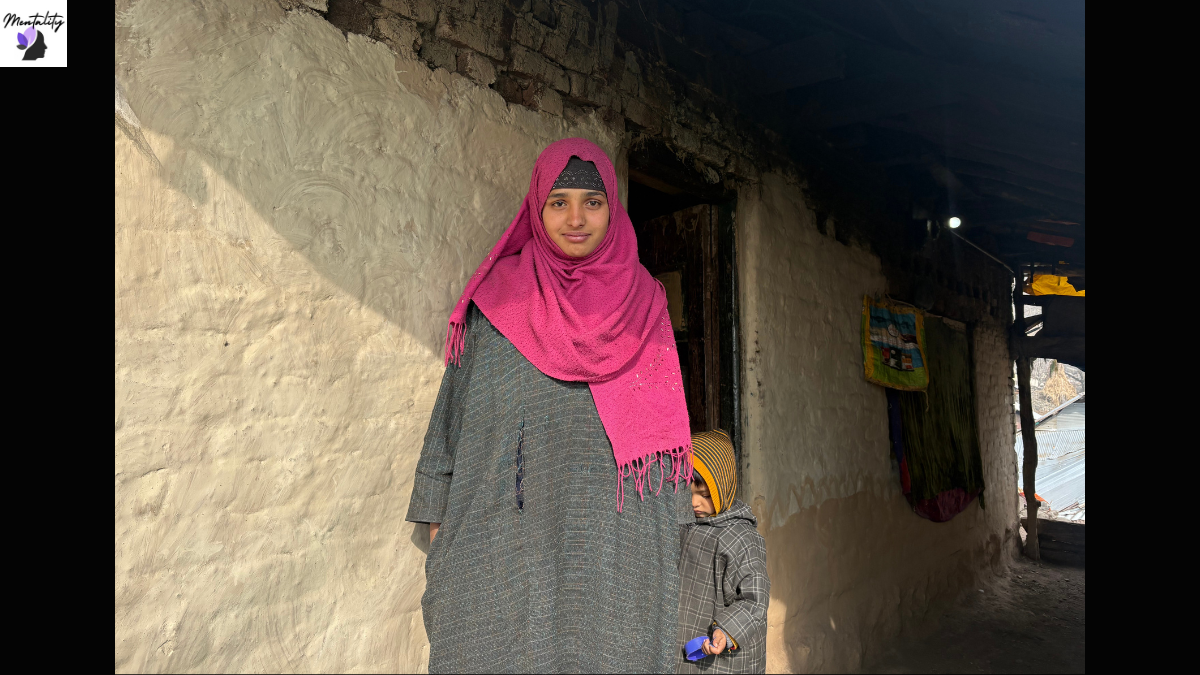
Urbanisation has caused Jaan’s life to be different from Begum’s.
Sometimes, her generation has the option of staying on in their villages when the men of the household migrate with livestock. However, the Amity University study The following year, noted’ “Nomadic identities are sometimes viewed by settled populations as “backward” or “unclean,” reinforcing social exclusion and self-doubt among the pastoral community.”
Although successive governments have invested in temporary mobile schools set up along the migratory routes of the communities, hostels and residential schools for Gujjar Bakarwal children, scholarships, and other benefits, many in the community said that the administrative delays, lack of documentation, and accessibility issues keep the younger generation from such benefits.
“Our children dream of a better life, but we cannot meet their demands. As a result, a fight breaks out frequently,” said Reshma Begum, a mother of four sons. “Teenagers are more fragile and sensitive. So, to control their anger, I get some water or taweez (amulets) from the peer (faith healer) to keep them calm and be accepting of this way of life.”
Mental health access
Jammu and Kashmir has mental health facilities concentrated in big cities of Srinagar and Jammu. “We see few patients from the tribal communities,” said Dr Arif Maghribi Khan, a Srinagar-based psychiatrist. But, merely having more hospitals will not solve the problem, he said. “Building trust among the communities will take time.”
Although research has pointed to high rates of stressors in the community, few among the Gujjar Bakarwals access mental health care. “People usually come only at a very late stage when symptoms become severe or disruptive, and the patient shows aggressive behaviour or acute social isolation” Dr Khan added.
Among these tightly knit communities, if someone admits to having a mental health problem, it is seen as something shameful, said Dr Rahi. “People are often unwilling to acknowledge psychological issues. Instead, many turn to faith healers, seeking taweez or blessed water, believing these will cure them,” he added.
Nomadic communities have distinct languages; therefore, providing mental health care in their languages is very important, said Dr Javaid Rashid, Assistant Professor, Department of Social Work, University of Kashmir. “They have their own language to interpret things, and it becomes difficult for an outsider to make sense of these experiences,” he added.
For Begum, mental health care is a luxury she cannot afford. “My mornings begin with cooking, cleaning, and tending to the livestock,” she said, “and that continues till night.”

Author: Baseera Rafiqi
Baseera Rafiqi is an independent multimedia journalist from Kashmir, India, who reports at the intersection of health and environmental studies