
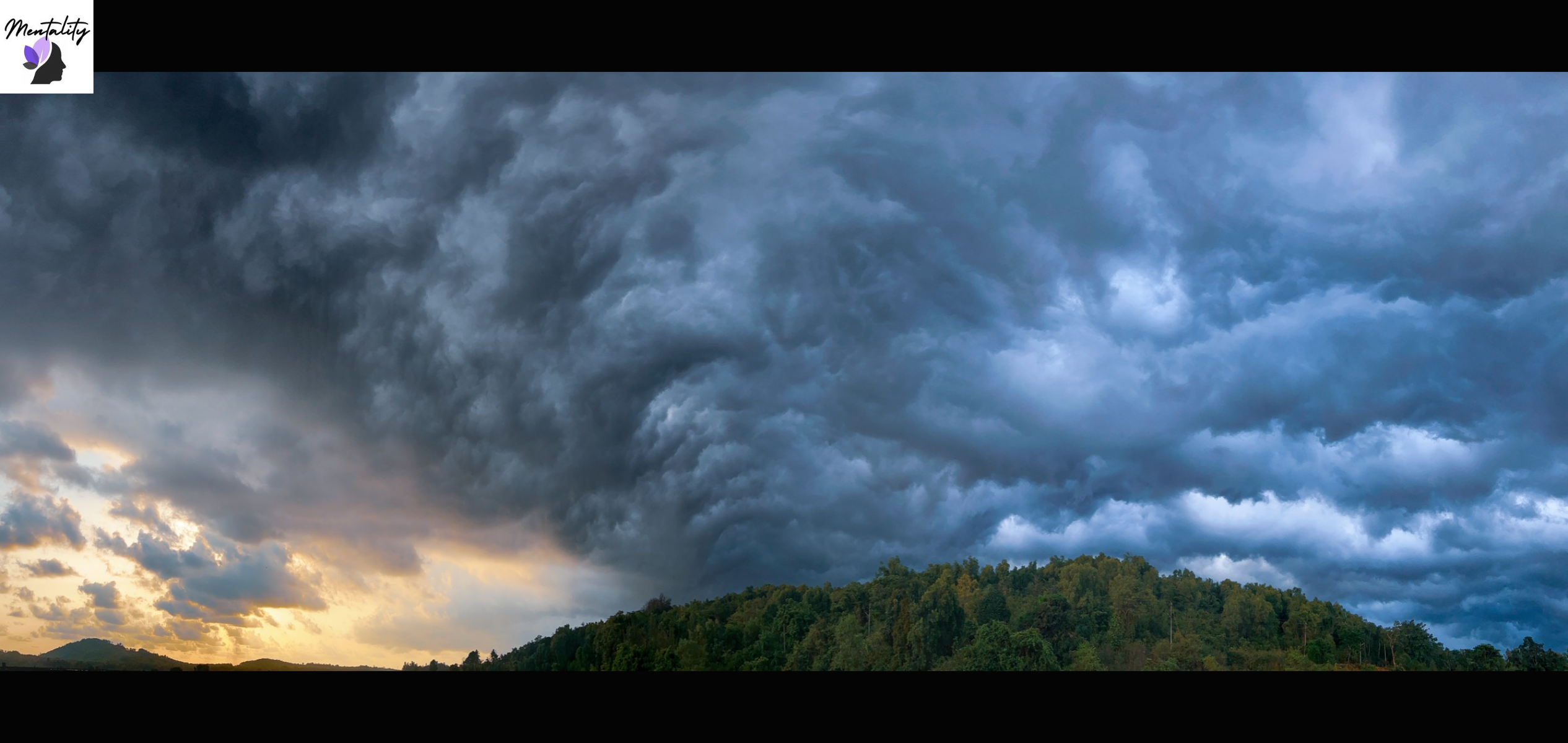
A storm in the salt fields where the author grew up (Image Credit: Aadya C Gaonkar)
By Aadya C Gaonkar
The composition of a human tear is 98.2% water, 1.1% organic compounds, and 0.7% inorganic salts. If you were to trace where my tears came from, you’d have to travel down the western ridge of the Indian subcontinent to a tiny, unassuming village called Torke.
Nestled between the lush rainforests of the Western Ghats and the popular town of Gokarna, my village runs parallel to the brackish waters of river Aghanashini. From the sky, a large portion of my village looks like a giant, hand-carved chessboard. It is a massive grid of shallow pools, filled with sea water that catches the sun like a thousand broken mirrors. Narrow paths of dried mud carve out the squares, some big, some small. but this is where they make the salt. The locals call it Uppu Nagara or Uppina Agara, Salt City.
It is from here that my tears get their salt. But the history of my tears itself is long and turbulent. This is the story of how I got depression, and it begins in 3500 BCE.
Nomads
My people have always moved with the land and its seasons. Around 5000 years ago, a small group of pastoral nomads traversed the vast grasslands of what is now Kazakhstan. I imagine a young girl like me, running barefoot across the plains, herding the sheep home as her father called her name. I imagine, years later, her heart must have broken watching her tribe split in two.
One went west to become those we know today as the Greeks and the Germans. The other went south, lingering in the fertile basins of the Indus Valley before the drying rivers pushed them further down the western coast of India. For three thousand years, we remained wanderers, on the fringes: herders, forest-dwellers, and restless travelers who could never quite settle. It wasn’t until the rise of the Vijayanagara Empire that our restlessness found a purpose.
In the late 16th century, the ‘Pepper Queen’, Chennabhairavidevi, did something few rulers in her position would have done. She gave us land, and she gave us weapons to protect it. It was a time of brutal violence. The Portuguese were clawing at our shores, desperate to monopolize the spice and salt trade of the Konkan coast. They burned ports, hijacked trade routes, and bled the estuaries dry. The Pepper Queen needed warriors. And we needed a home.
For generations, our minds were forged on this battling coast. When the gunpowder settled, we turned our gaze from the sea to the mud. In the shallow estuarine pans of Torke, we learned to harness the sun and the tide, trapping the Aghanashini’s might and minerals until it evaporated into brown, muddy salt.
Perhaps that is when we ceased to be warriors on horseback and became the keepers of the Earth. And when the regional caste registers were codified, they gave us a new name: Nadava, people of the land.
Independence Day
In the summer of 1930, on a scorching day in April, my great-grandfather heaved thick, golden bundles of straw across the field, lugging them over his shoulders. He used them to cover the salt mounds before the British could confiscate them. The colonial government had placed a heavy tax on every grain of salt harvested from our pans, declaring it illegal for us to collect or sell our own yield without paying tribute to the Crown. The land we had fought for was now policed by foreign laws.
So, when news reached the coast that a frail old man in white—the one they called Mahatma—was rallying against the British Raj, my great-grandfather and many others joined him. For days they marched, under scorching summer sun, Gandhi’s voice flying across a massive, turbulent coastline. Their stand along the coast of Sanikatte would forever be remembered as the Salt Satyagraha.
Seventeen years later, the war was won. We were now an independent nation. But there raged another battle in my great-grandfather’s mind. It’s hard to know the exact cause, but he turned to country liquor, spending his evenings of freedom buried in the bottle. In his moments of sobriety, he would look at his son, my maternal grandfather, and tell him this, over and over again:
“Ni odbeka, Goutama. Shali hogbeka. Madaddella entak mathe?” (“You must study, Goutam. You must go to school. Otherwise, what was it all for?”)
Taking his father’s words to heart, my grandfather would go on to become a teacher.
Even today, when I walk with him in our quaint little village, at least three people stop to speak with him. These are students from ages past. And, so, began a new shift in the story of my family. Enough wars had been fought, enough blood had been spilled. Education was the new north star. Yet in staring only at a north star, it becomes terrifyingly easy to walk straight off a cliff.
Atlas
In February of 2026, I sat in the muted white corridors of the hospital where my father had died, holding a prescription in my hand. It read:
Zosert 25mg 1-0-0 (10 days),
Zosert 50mg 1-0-0 (10 days), and
Zosert 100mg 1-0-0 (continue for 3 months).
My mother, whose story will have to wait since she deserves a book of her own, stood at the billing counter. I could feel the eyes of the blue-clad nurses watching me, whispering to each other, “Is that her?” “Yes, yes, his daughter…” I even thought I heard a snicker or two. My father was a local legend here, a surgeon who spent more time admitted in the hospital than doing his actual job. It wasn’t their derision that upset me—I was far too used to it—it was the sky.
It was a brilliant, perfect blue.
What had it looked like the day my father died, four years ago? Was it choked with storm clouds, or was it vast and unyielding, when it finally crushed my Atlas to his death?
I call him Atlas because that is what he was to me: a Titan.
When I was born, no one could wipe the smile off his face. I was his little girl. He would call me princess, carry me on his shoulders, and take me out in the evenings when he wasn’t in the hospital. I would chatter away in the car, which always smelled like fresh peppermint, telling him all about my little problems.
It never occurred to me to ask him about his.
But I was not the only weight he carried. Trauma, like history, is a master of repetition, regardless if you carry a bag of salt or a surgeon’s scalpel. When our family turned to education as its salvation, perfection became a daily demand. My father was a victim of this system. His mother, who outlives him still, beat him, belittled him, and used violence and fear to forge herself a flawless son.
It is this weight that my Atlas carried all his life. A weight that eventually pushed him to self-medicate with the very anesthesia and narcotics he used on his patients. As I entered my teenage years, I watched the slow and terrifying unraveling of my father. The long years of substance abuse, the violent outbursts, even a touch of madness…until the man I thought was invincible lay peacefully asleep in the arms of death.
The composition of a human tear is 98.2% water, 1.1% organic compounds, and 0.7% inorganic salts. We tend to think of tears as purely emotional, but our biology keeps a much older record.
Major Depressive Disorder (MDD) has a genetic heritability rate of roughly 40%, while the same for conditions like Attention Deficit Hyperactivity Disorder (ADHD) sits as high as 80%. When a population undergoes prolonged environmental stress – war, displacement, and colonial oppression, the trauma stops being an event and becomes an inheritance. My father was born into that debt. And so was I.
For almost a decade, I lived trapped inside a mind I couldn’t control, consumed by grief, anger and a denial of the illness that was taking over me. In my darkest moments, I was terrified that I was doomed to follow my father into the abyss. It kept coming back to me…the awful truth Sophocles spoke of, “I am forced by tragedy to act as I do; I know my own madness, but I cannot escape the blood from which I came.” But what Sophocles didn’t know is that my blood, and my tears, carry salt. And salt is not a poison; it’s a preservative.
So, I look at every tear I have shed, and I see the salt inside it not as fate, but as a friend. That salt has been traveling through my bloodline for centuries: from the vast plains of Kazakhstan, to the undulating coast of south-west India, where it bloomed in our blood, sweat, and tears.
It’s the only thing that has remained steady and constant, reminding me that my father’s grief may have been a mountain on his back, yet he still found the strength to carry me in his arms.
I hope, wherever he is, he knows that I’m doing better now. I hope he’s running free and unburdened, tasting the salt in the air and knowing that it is also in me.
***
This essay was chosen as one of the top ten essays entered for the Mentality’s essay writing competition 2026.
Author: Aadya C Gaonkar
Aadya C Gaonkar collects shells, loves reading books, and believes in fairytales.