
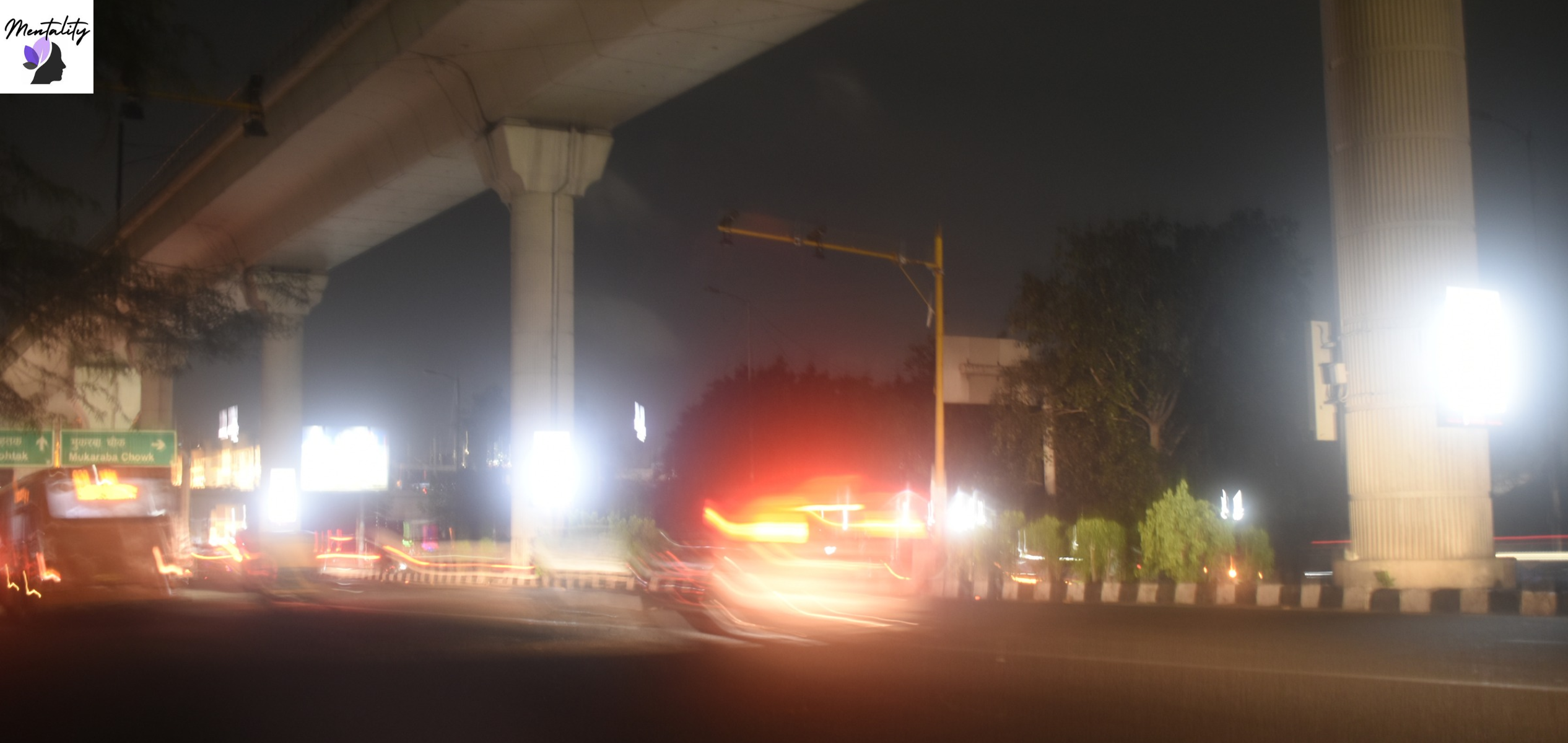
In cities like Delhi, absence of darkness is a common feature of the urban landscape (Image Credit: Monish Upadhyay)
By Monish Upadhyay
Nightlights are needed for many reasons, including safety. However, its impact not only ranges from poor sleep quality to hormonal imbalance but also a higher risk of anxiety and depressive symptoms.
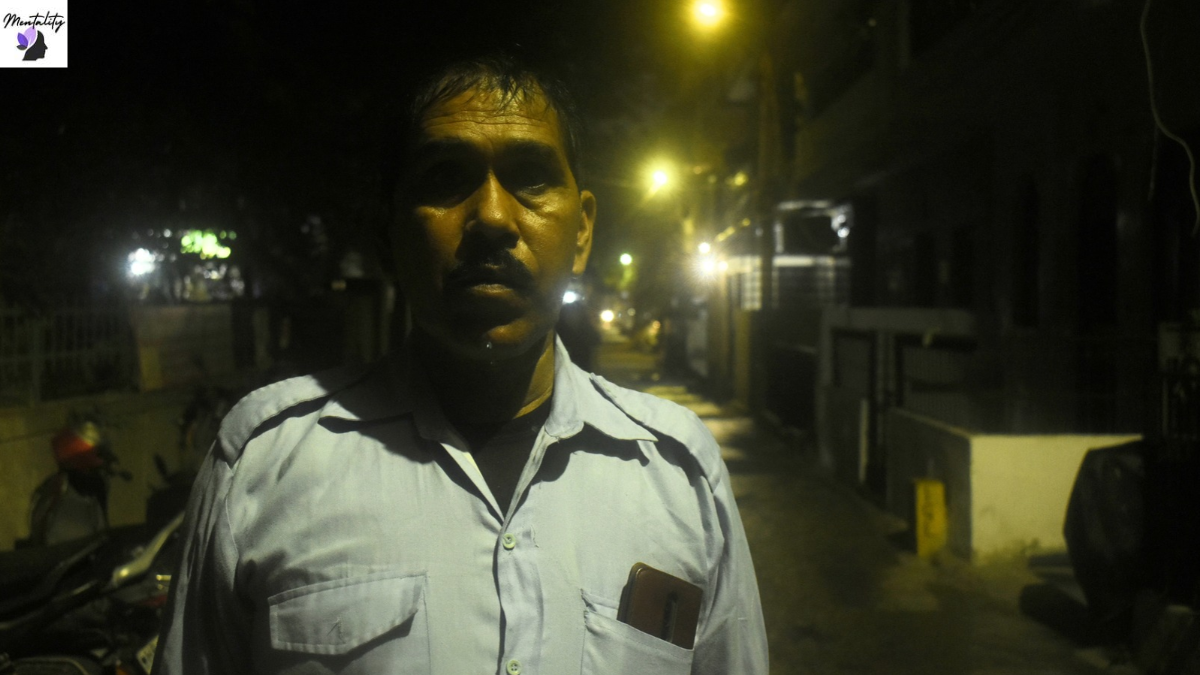
Fifty-five-year-old Raja Ram places a plastic chair in a dark corner below an apartment complex in West Delhi’s Paschim Vihar. Before he can even get comfortable on it, during summers, he places an electric fan near his feet to avoid mosquito bites. “I always try to sit in darker places since the streetlights give me headaches,” he said. Except, for about ten years now, all of Ram’s work hours are under streetlights.
As a nighttime security guard, who gets to sleep only when the sun comes up, he has pronounced dark circles around his eyes.
In many ways, Ram is considered to be the victim of light pollution, defined as excessive, misdirected, or obtrusive use of artificial light at night that disrupts natural environments, human health, and visibility of the night sky.
“Humans are diurnal organisms,” said Neelu Anand Jha, an associate professor at O.P Jindal Global University, whose areas of expertise include circadian rhythms, light pollution and sleep. “Our physiology is tuned to sleeping at night.”
However, she said, many people are exposed to a lot of light even during night hours, which affects the formation of melatonin and, thus, impacts the circadian rhythm.
Chronic sleep disruption can have a host of cognitive and physiological consequences said Dr. Neelam Mishra, a psychologist at Delhi’s Sri Gangaram Hospital. “Circadian rhythms regulated by hormones such as melatonin and cortisol may continue to follow their biological timings even when a person’s routine has shifted to nighttime. This can create a mismatch between the person’s schedule and their internal physiology,” she added.
A decade ago, when Ram moved from Uttar Pradesh’s Shahjahanpur district to Delhi, he only focused on how much more he would get paid. After all those years, he takes home Rs 11,000 every month, and of this, he spends around Rs 900 on medicines, he said. “I get fevers regularly and even my hands and feet are swollen at times,” he said.
But Ram had never considered the cost of his mental wellbeing. In part, because he could not afford to.
Raja Ram works as a night watchman and often complains of headaches after sitting long hours under streetlights.
People who are exposed to light 24 hours a day can experience difficulty in concentrating, suffer from headaches and irritability, and face a higher risk of anxiety and depressive symptoms, said Dr Mishra.
Let there be light
A 2021 satellite-based study found that Delhi had the largest area of artificial nighttime brightness among the ten most-populated Indian cities, including Hyderabad, Bengaluru, Mumbai, and Chennai. “Where and how much are important keys to responsible outdoor lighting”, said Tina Pujara, the professor in-charge of the research group ‘Happiness by Design’ at Department of Architecture and Planning, IIT Roorkee.
Ayesha Naz, a student pursuing her bachelor’s degree, lives near Old Delhi’s Ajmeri Gate. Narrow lanes snake through the historic neighbourhood, with no clear demarcation of residential and commercial areas. Since her house is situated near a cluster of food shops and kiosks, streetlights are a necessity. “I hardly get to sleep with all that light coming from outdoors,” she said.
Naz said she had grown weaker in the past few years. “I think my routine now leaves me completely tired and exhausted,” she said, adding that not being able to rest is the biggest reason she falls ill more often.
According to the 2018 National Sample Survey, 93.5% of Delhi households had a direct opening to a road, lane or constructed path with street lighting.After all these years, little changed.
Sleep loss alters cortisol, growth hormone, insulin, leptin, and other hormone systems, said Dr Mishra. “The normal timing of hormone release can also become less coordinated”, she said. Among women, premenstrual symptoms can feel even more intense, she added.
Safety in well-lit places
Safetipin, a social-impact organisation that uses technology and data to assess the safety and accessibility of public spaces, had mapped around 7,438 dark spots in 2016 in the national capital; these were reduced to 2,768 by 2019 and, finally, 727 in 2023. “We talk about lighting as a big component of feeling safe,” said Shreya Basu, the head of Partnerships and Growth at Safetipin “especially for women in public spaces.”
Naz walks for a kilometre to catch a metro in the wee hours of the morning. “I feel unsafe when I have to walk since there are men loitering around and the streetlights are switched off,” she said.
So, the answer to ensuring well-lit urban spaces that make women feel safe, while not creating more light pollution is to have better quality of nighttime lighting in cities, said Jha.
In May 2026, the Delhi government had announced that it would replace nearly 96,000 streetlights with advanced smart LED systems, where brightness and schedules can be controlled. However, it is not clear how many have been installed yet.
In many countries, nighttime lighting tends to be dimmer and warmer, said Jha. In dense neighbourhoods, such lighting conditions are seldom met, she added.
Nights for relaxing
Twenty-three-year-old Arijit Gupta lives in Govindpuri, a densely populated neighbourhood in Southeast Delhi. In 2024, Gupta moved from West Bengal’s North 24 Parganas to New Delhi for his studies. He works as a journalist now. Gupta said his biggest loss in a fast-paced work environment is the ability to take a moment’s pause. “I miss going to the terrace with my sister and dog, all of us just watching the sun slowly set,” he said, “we used to gaze at stars late into the night.”
Given Delhi’s dirty air and a lack of access to the terrace, he can hardly see the stars now, “So, I miss the calm that night times bring.”
Ram feels the same way. “I miss those quiet nights where I would sleep in my farm and see the night sky.”

Author: Monish Upadhyay
Monish Upadhyay is an independent journalist based in New Delhi. Interested in arts, cinema, environment and human rights, he also enjoys photography as a medium of storytelling.