
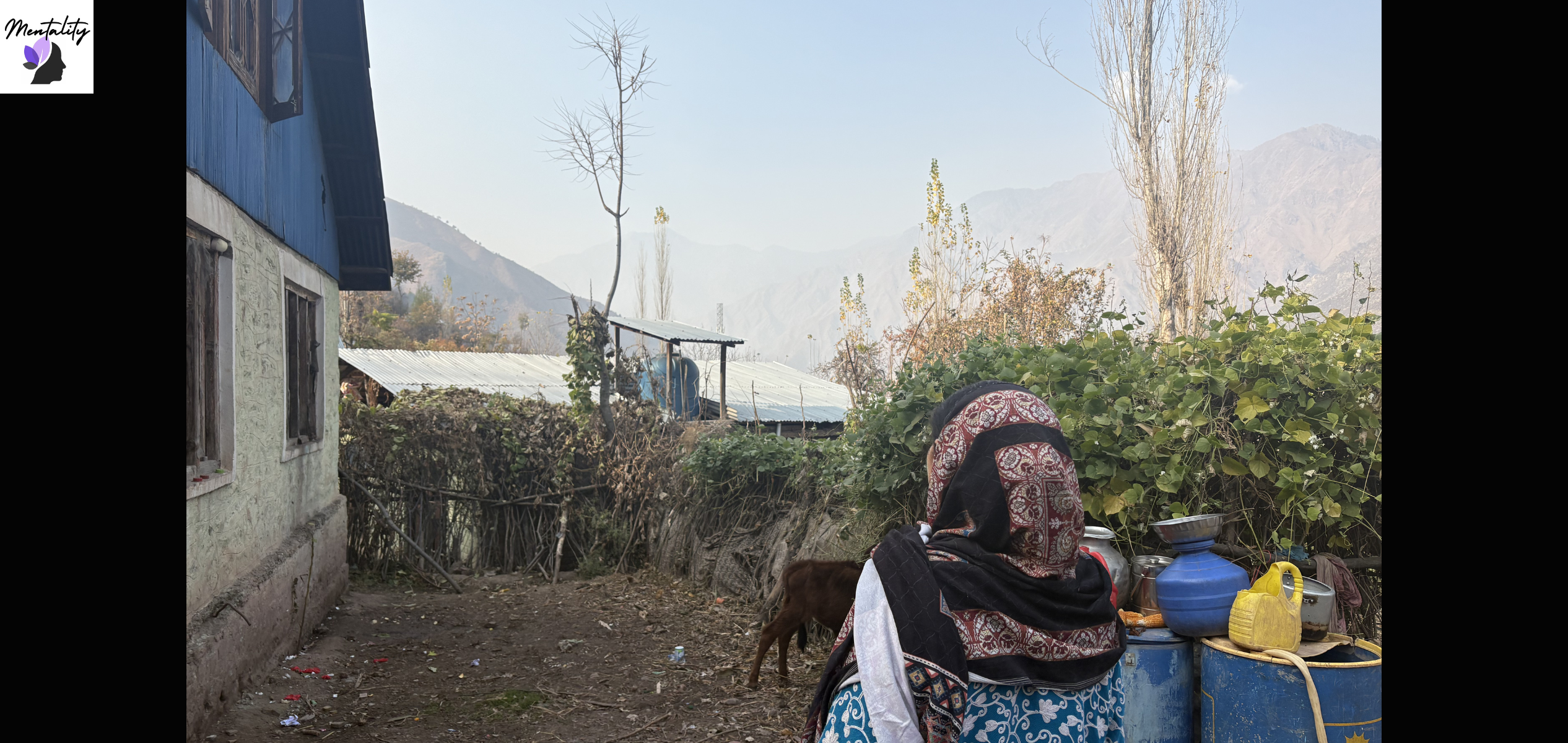
Shamima Manzoor points out the nearby mountain range, which falls within the Pakistani region, from her village Jablah. (Image Credit: Raihana Maqbool)
By Raihana Maqbool
Decades of living with cyclical conflict has built a fragile resilience in border areas of Jammu and Kashmir. But long-term living with the unpredictability of violence breaks people.
In the dead of the night on 8 May 2025, Shamima Begum was jolted awake by a thunderous noise. She sat up in horror. Her house in Jablah village in the Salamabad area of Jammu’s Uri district had been caught in the crossfire between India and Pakistan yet again.
Both countries were firing missiles at each other after a terror attack in Kashmir’s Pahalgam on 22 April 2025 left 26 tourists dead. India blamed Pakistan for instigating the attack and began firing missiles on 7 May. Things got worse from there on, with multiple Indian and Pakistani cities as far as Srinagar, Amritsar, Sirsa, Rawalpindi, and Bahawalpur becoming targets.
A year on, the residents of villages across the Line of Control (LOC), the de facto border between India and Pakistan, are still dealing with the uncertainty of missiles hitting their homes.
On that day, Shamima Begum’s 23-year-old daughter, Muskaan, let out a loud cry as she heard the noise. She clutched her chest, complained of immense pain, and fell unconscious within minutes, recalled Shamima Begum. Her son, Manzoor, put her on his scooter, tied her to himself with a scarf, and rode straight to the hospital at 4 am even as there was shelling in the area, she said. “It was traumatising.”
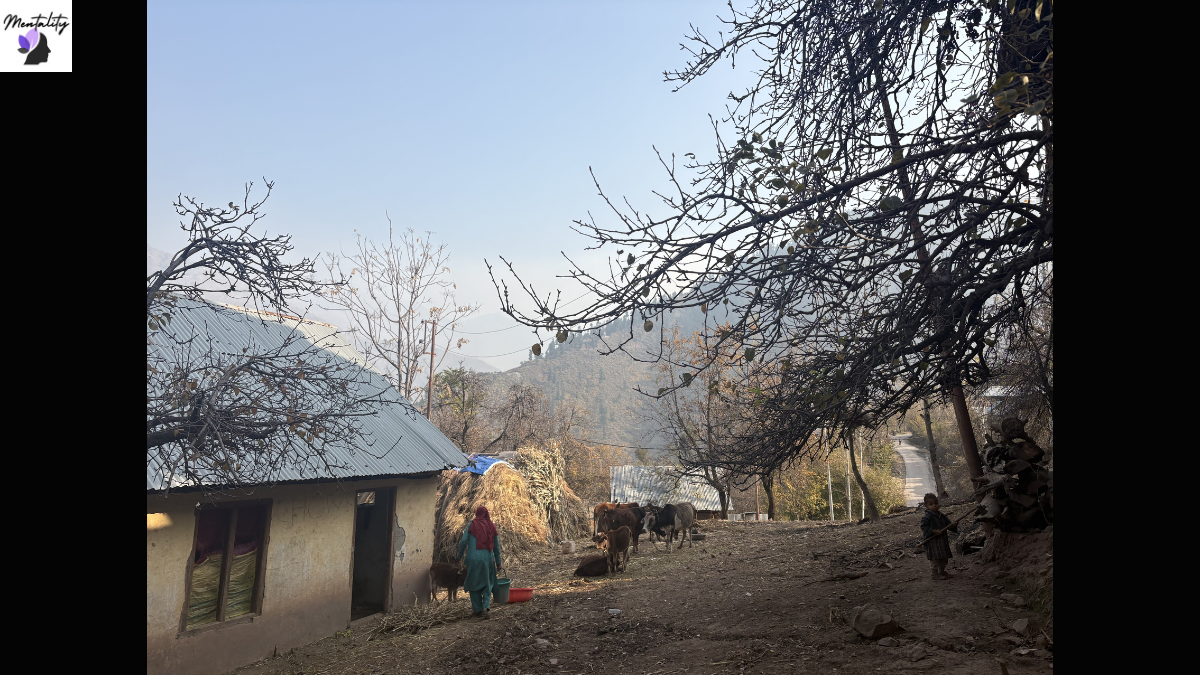
The following day, with the missiles falling on their villages, Muskaan was discharged from the hospital with no major diagnosis. But her fear of loud noises didn’t leave her.
A few months later, when firecrackers were being burst at a wedding, Muskaan started crying, covering her ears, Shamima Begum said. “She was constantly asking for help,” she said. “She lives with nightmares, trauma, and anxiety now.”
When shelling happens, everyone predominantly focuses on physical damage, destroyed houses, infrastructure, and the like, said Dr Abdul Majid, Head of Psychiatry, Sher-i-Kashmir Institute of Medical Sciences, Srinagar. “But nobody actually ponders much on the long-term or short-term consequences when it comes to mental health or what happens to the mind,” he added.
Cross border shelling
The LOC is about 10 kilometres from Shamima Begum’s house. The LOC was the default Ceasefire Line in 1949 following the first India-Pakistan war. Both militaries patrol this line constantly to ensure strategic locations like hilltops, outposts, or buffer zones are not seized by the other. About 740 kilometres of the LOC lies in Jammu and Kashmir, from Akhnoor in Jammu to the Siachen region. Along this border, there are 2,234 villages.
Cross border shelling is not unusual for people in these villages. Every time there is firing across the border, the residents’ livelihood and education is disrupted, livestock is lost, and homes, hospitals, and schools are damaged.
Decades of living with cyclical conflict has built a fragile resilience in border areas, said Dr Majid. In Uri, Rajouri, or any other border areas, violence has been constant for many decades. “To some extent, a certain amount of resilience and understanding exists, but unpredictability breaks people,” he added.
“My mind never stops thinking about ‘what if it happens again’ and how to deal with it,” said Shamima Begum, “but I try to stay strong for my children.”
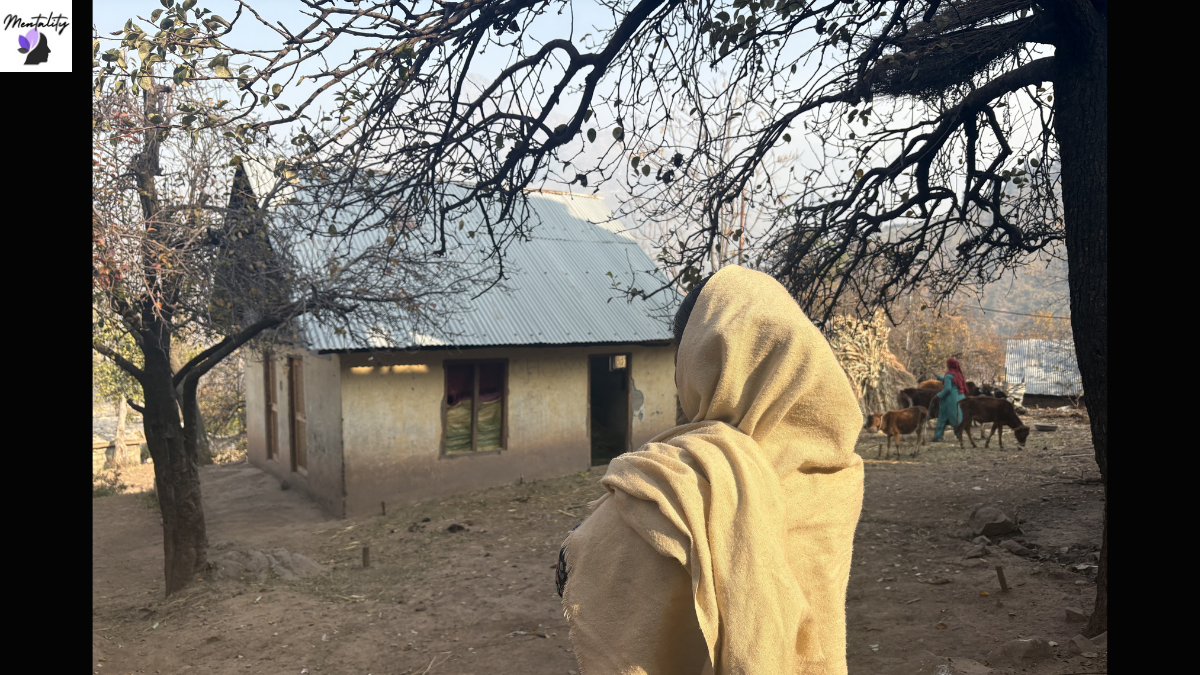
Sharbat Bibi, 38, lives in Nowpora village, around 14–15 kilometres from the border adjoining Pakistan. She said she has been hearing the sounds for decades now. “When we hear loud noises, we put cotton in children’s ears, so they don’t panic,” she said.
While a lot of people have moved, families like that of Shamima Begum have stuck around. “I want my kids to settle somewhere else,” she said.
Leaving is not an option
Bani Begum (no relation to Shamima), 50, a mother of eight, said she wanted to send her children away during the May 2025 escalation. “If we had enough money, we would send our kids to other areas like Baramulla to study and live there,” she said. Her husband does odd jobs and earns a daily wage.
When there is shelling across the LOC, sirens go off signalling to the villagers to find the closest bunker. But not everyone can fit into bunkers, said Bani Begum. “We all gather in one house, and, at that time, the only support we have is each other,” she added.
Bani Begum’s daughter Shaneela’s body shivers every time there is a loud noise that sounds like a missile.
The 2021 ceasefire agreement between India and Pakistan was the last major one that held a relative peace. In May 2025, that fragile peace was shattered, with violence and uncertainty returning the lives of those in border villages.
After the Pahalgam attack, India suspended the Indus Waters Treaty, a water-sharing agreement between the countries. In response, Pakistan threatened to exit the 1972 Simla Agreement, which formalised the LOC. That gave a lot of the residents of Nowpora, Uri and other border districts sleepless nights because the LOC was formalised during the Simla Agreement and both countries agreed to not alter it unilaterally.
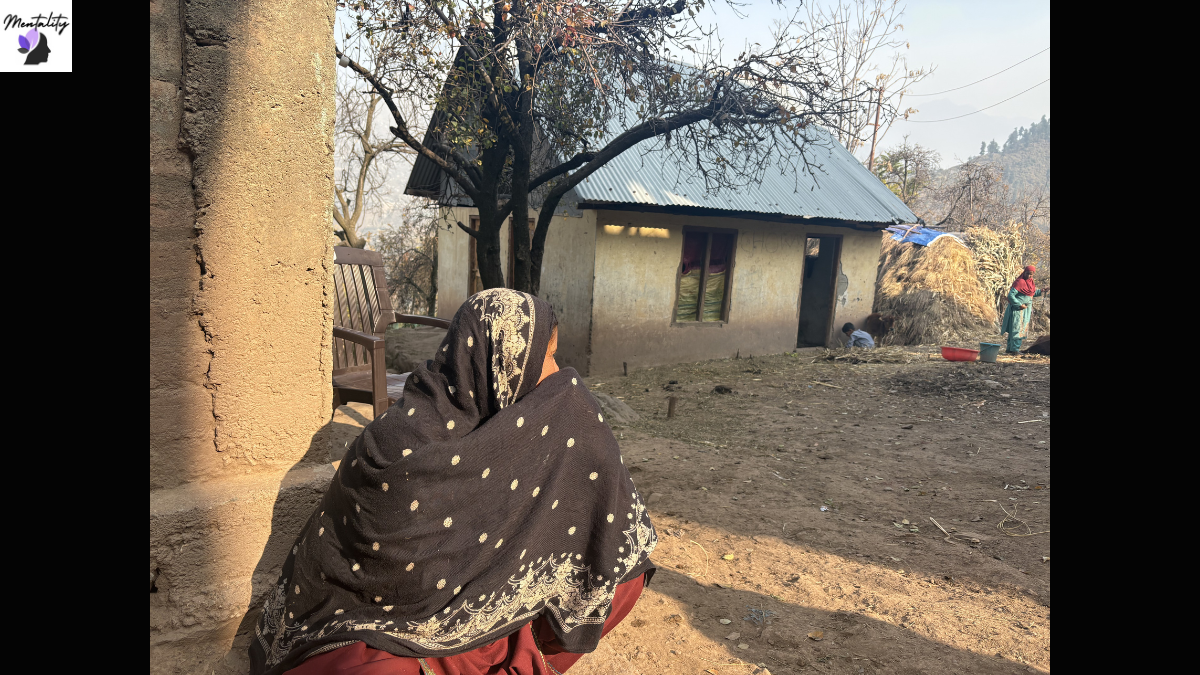
Education is a ticket out of these villages, but schools and colleges are constantly disrupted when violence erupts. Fowzia Amin, 20, a student of computer sciences said she cannot focus on her studies. “I have dreams and aspirations, but the relentless uncertainty doesn’t allow me to focus,” she said.
Lack of mental health facilities
The closest tertiary care hospital to most border villages of this region is in Uri but it doesn’t offer mental health care. “We don’t have money to go to Srinagar or even Baramulla,” said Shamima Begum.
Although medical camps are organised in these areas, there are no specific ones for mental health. In the absence of institutional support, women in these villages turn to faith and each other for support. “When we sit together during shelling, we only remember God. That is the only peace we get for a while,” said Bani Begum.
When Bibi was unable to sleep during the violence and complained of excessive headaches, she was offered some medicines. “Those only helped for a little while,” she said. Many women who suffer trauma come with headaches, stomach pain, or loss of appetite, said Dr Majid.
A relative suggested Bibi visit a faith healer, and Bibi did so as she saw no other option. “He recited some prayers and gave me water to drink,” she said. “That offered some relief.”
Manifestations of stressors
Women from border areas often complain of physical symptoms as their bodies convert psychological symptoms into physical ones, said Dr. Syed Mehvish, Assistant Professor in the Department of Psychiatry at Sher-i-Kashmir Institute of Medical Sciences (SKIMS). Their trauma transforms into pain, and they do not respond to routine medication because the root cause is psychological, she said. “Painkillers usually provide little relief,” she added.
“We receive many referrals from gastroenterology as well,” Dr Mehvish said, adding that doctors report that patients do not improve despite treatment and suspect there is an underlying psychological cause. “When we explore these issues in depth, we come to understand these underlying factors of trauma and fear,” she said.
Shamima Begum said she has not had a good night’s sleep in a long time. “My mind never rests, and I’m always thinking about what will happen next,” she said.

Author: Raihana Maqbool
Raihana Maqbool is an independent journalist based in Kashmir, reporting on the intersections of science, gender, health, politics, technology, and related social issues.