
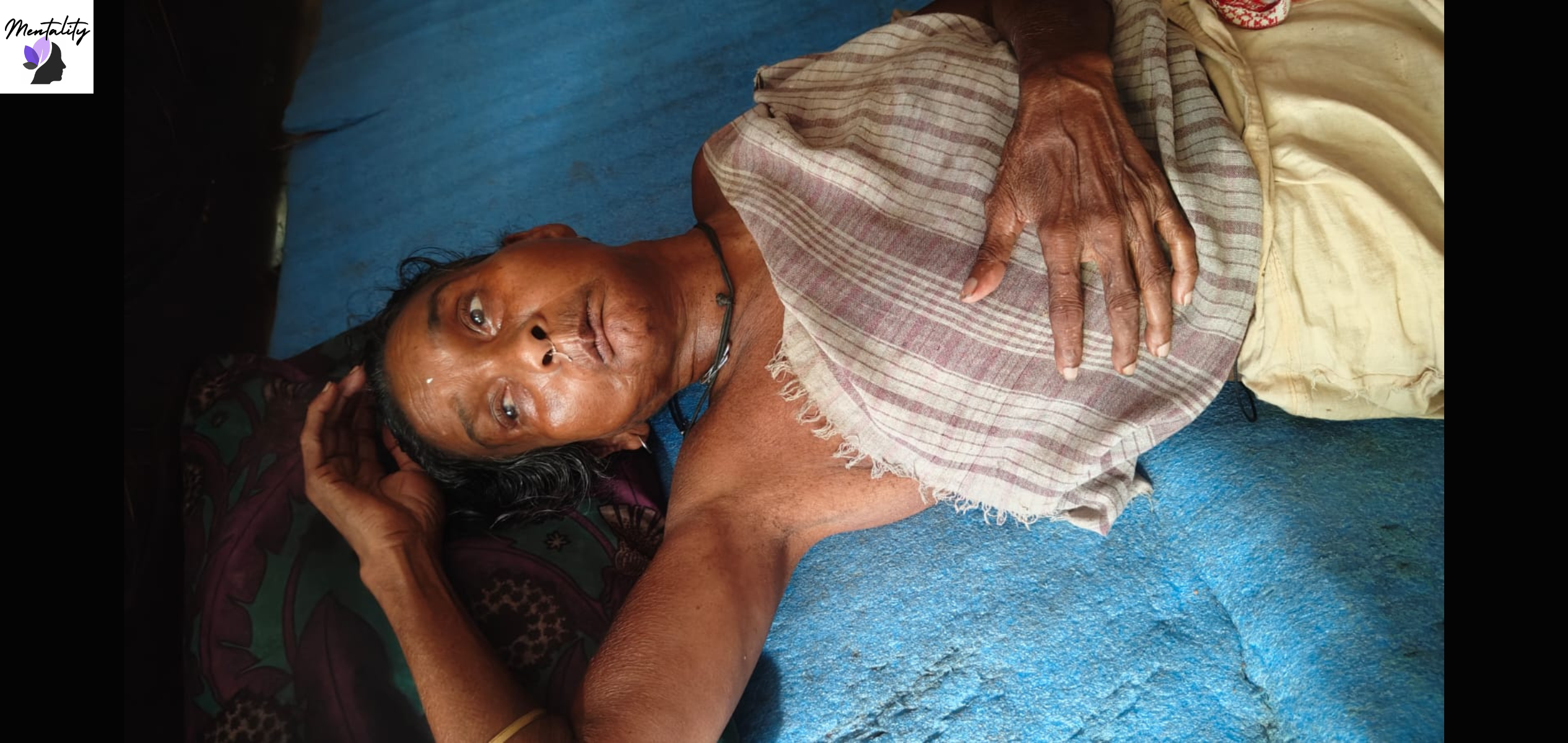
Maleka Begum (68) in her bed in Baniarapara village in Barpeta district of Assam (Image Credit: Faruk Khan)
By Syeda Ambia Zahan
A majority of people in Assam who were excluded from National Register of Citizens suffer mental torture, trauma, and humiliation. At least 60 people died due to the stress caused by the process in Assam. Many among them took their own lives.
Every night, 68-year-old Maleka Begum dreams she is crawling through mud drenched by rain. She slips again and again and starts to disappear if she stops crawling.
She wakes up startled, with a racing heart, soaked in sweat and tears in her eyes.
Thirteen months ago, Begum returned home to Baniarapara village, 10 kilometers from Barpeta town in Assam, after she had been deported to Bangladesh.
Yet, according to her family, she has never truly returned.
This is not the same person who used to wake up early, feed her roosters, help her daughter-in-law with household chores and visit her neighbours to share a cup of red tea with them.
She is always in bed these days and hardly eats or rarely speaks, said her husband, Suleiman Khan. She no longer tends the kitchen garden that once occupied much of her day, nor does she visit neighbours like she used to. The woman, once cheerful, talkative and constantly on the move no longer exists, he added.
Thirty years ago, Begum began the battle to prove her Indian citizenship. Her mental health and her body bear the imprint of that struggle. She lives with diabetes, chronic body pain, breathlessness, and heart issues, and she has difficulty walking.
“The diabetes developed during her years in Kokrajhar detention camp in February 2016,” said her 70-year-old husband. “But she started to have sleeplessness and nightmares after she was forcibly pushed into Bangladesh in May 2025.”
Like Begum, many people have been kept on their toes trying to prove their citizenship since Assam started updating its National Register of Citizens, a citizenship verification exercise, in 2019.
About 90% of the 41 lakh people who were excluded from National Register of Citizens, suffered mental torture, trauma and humiliation, said a 2019 survey by the National Campaign Against Torture, a coalition of NGOs. It documented widespread anxiety, depression, sleeplessness, financial distress and loss of livelihood among families caught in the process.
“Long-term stress linked with physical safety and financial precarity results in prolonged exposure to stress hormones like cortisol and adrenaline, which can slowly degrade cognitive function and bodily processes over months or years,” said Dr Anant Bhan, a public health researcher working on bioethics and mental health. “Constant stress significantly increases the risk of developing clinical depression, generalized anxiety disorders, and substance abuse.”
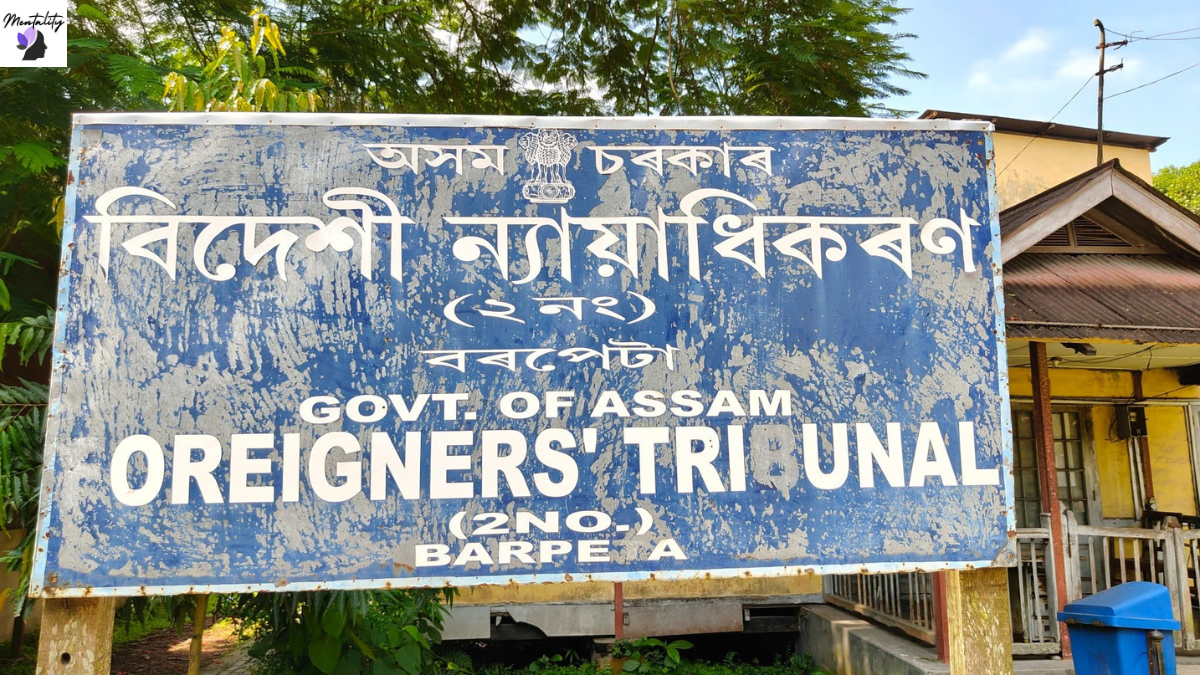
Faruk Khan, a 49-year-old social worker, has been helping hundreds of people sort out documents, accompanying them to Foreigners Tribunals, police stations, and courts since 2019. “Most people talk about citizenship, detention camps, and court cases,” he said, “nobody talks about the psychological decline of an entire community.”
According to Khan, the trauma often begins long before a person enters a detention centre. “The day someone receives a notice from the Border Police or a Foreigners Tribunal, their life changes,” he said. “On the days they have to appear before the tribunal or mark attendance at the police station, they are like dead bodies,” he added.
According to the Citizens for Justice and Peace, a human rights organisation, 60 people died due to the stress caused by the citizenship verification process in Assam in 2019. Many among them took their own lives.
Trauma of not belonging
In some cases, a single traumatic event can lead to post-traumatic stress disorder (PTSD), said Dr Jayanta Das, a Guwahati-based senior psychiatrist. “One of the common symptoms of PTSD is social withdrawal. A person may stop talking, avoid social interactions, and prefer to remain isolated because they no longer feel safe.”
The immediate psychological symptoms often include sleeplessness, loss of appetite, poor concentration, memory disturbances, anxiety, depression, and frequent nightmares, he added.
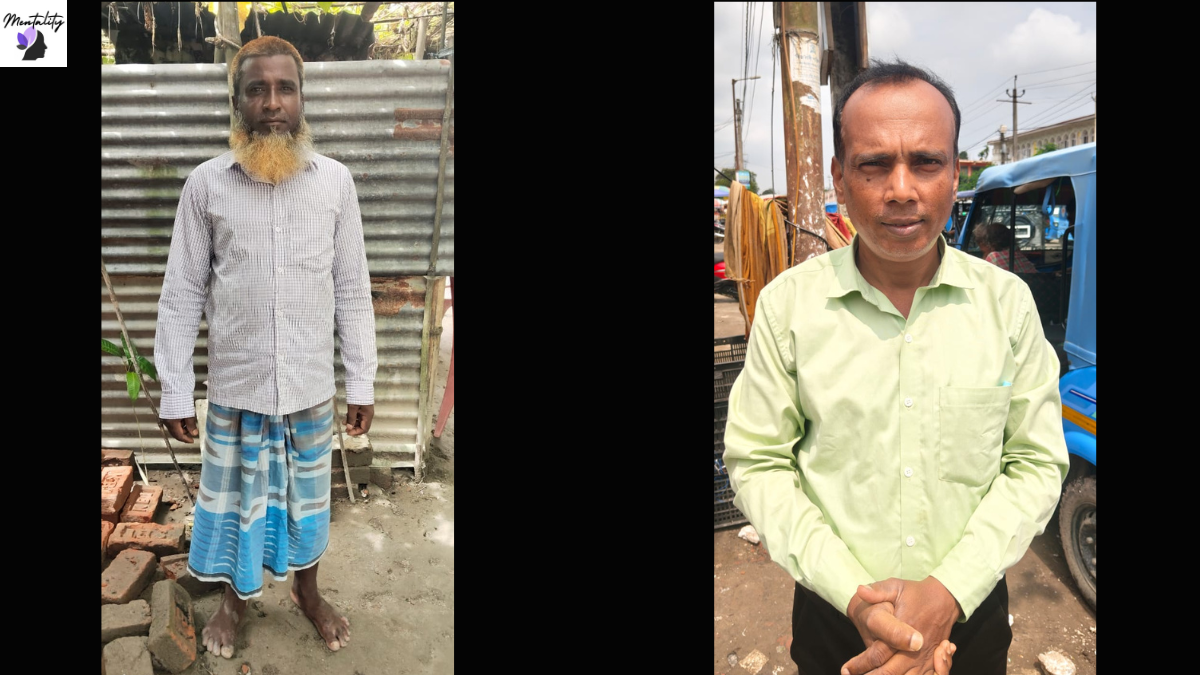
Fifty-year-old Shohidul Islam, from Pub Kalgachia village in Barpeta district, said he recognised every one of those symptoms. “My stress has become permanent.”
Though he still interacts with family and friends, he rarely leaves his home. Islam was picked up in 2011 while working as a daily construction labourer on AT Road in Guwahati. “They took me to Pan Bazar Police Station and recorded my details.” In February, 2019, he received a notice asking him to appear before the Hedayatpur Foreigners Tribunal to prove citizenship.
“I submitted all my documents to prove my citizenship. My wife, my father and my younger brother came from Kalgachia to give statements.”
He diligently showed up at multiple tribunal hearings over many months . In October, 2019, everything changed. “The magistrate called me inside the tribunal. While I was there, four policemen came carrying pistols. They pushed me around, grabbed me by my waist, and took me to Pan Bazar Police Station. They took my fingerprints, sent me for a medical examination and, the next morning, I was taken to the Goalpara detention camp.”
He remained in detention for 23 months, from October 2019 to September 2022, before obtaining bail from the Gauhati High Court.
At the detention camp, he said, his body would start shaking suddenly. “I developed a heart disease. I keep asking myself, “Why did I have to go to jail?”
Twenty-seven years of uncertainty
In 1997, a case was first filed against Begum by the border police for being a “Doubtful Voter,” that is, a person whose Indian citizenship is questioned by the election authorities in Assam.
The border police would refer such a person to a Foreigners Tribunal, where they would be put on trial to prove their citizenship. In 1998, the Border Police in Barpeta referred her case to Barpeta Foreigners Tribunal. Although all of her brothers and sisters were recognised as Indian citizens, the tribunal declared Begum a foreigner in 2012. The Gauhati High Court upheld the decision three years later.
She spent six years in the Kokrajhar detention camp before being released in September 2019 after a Supreme Court orderdirecting the release of those who had spent more than three years in detention.
Freedom came with conditions. Every Thursday, she had to report to Barpeta Sadar Police Station. For nearly six years, she never missed a single attendance. Then, a police officer asked her to come to the station on 25 May 2025, a Sunday. He told her something she had waited years to hear.
Her case had been closed, he said.
But it didn’t turn out to be what she thought it would be.
On the same day, she was detained and, later, pushed into Bangladesh.
Her family didn’t know she was being shoved into a neighbouring country.
For nearly a month, they did not even know whether she was alive.
A mind trapped across the border
It was barely dawn on 26 May 2025 when Begum began crawling up the muddy bank of a pond for the first time. She slipped repeatedly but kept dragging herself forward, crying for help. This was not her dream.
The previous night brought relentless rain. May is not usually a month of heavy showers, but nothing about that night was ordinary: not the rain, not the place where she found herself, and not the ordeal she had endured.
Through the mud she kept screaming, “Help me.”
Hearing her cries, Sabed Ali, a 55-year-old local body official, stepped out of his house overlooking the pond. “I am Maleka Begum. Please help me,” she pleaded.
It was around four in the morning, and Ali was still groggy from sleep. As he walked closer, he saw Begum covered in mud. She could barely stand, he said.
Ali took her inside his house. His wife gave her one of her own saris to change into and handed her a glass of water. Begum slept on the floor for a couple of hours.
Upon waking up, at first, Begum struggled to understand where she was. Her first worry was that her roosters had not been fed. She had to make tea for her husband before he left for work.
Within minutes, fragments of memory returned. She remembered travelling to Barpeta Sadar Police Station the previous day to mark what she believed would be her final weekly attendance.
Then came the realisation. She was no longer in Barpeta, not even in Assam. In fact, she was no longer in India.
She remembered being taken from the Barpeta police station to a detention camp in the adjoining Goalpara district. She remembered spending the night there inside a cell before being pushed into a police vehicle with around twenty-five others. They were driven for hours through the darkness to the India-Bangladesh border in Mankachar in South Salmara district and forced across after a heavy gate swung open.
The pond where Sabed Ali found her was in Bualmari Char in Bangladesh’s Kurigram district, which borders South Salmara district of Assam.
Children of the detainees
Islam’s wife began working as a domestic worker while he was in detention. His eldest son abandoned his education before attending college. His daughter failed her Class 10 examination. “My children hardly smile anymore. They are always angry about something,” he said. “They have almost stopped talking. When I had difficulty getting my daughter married because of my citizenship case, she became extremely withdrawn.”
Children who experience constant stress, watching their parents and families facing adverse situations, end up going through heightened emotional sensitivity, struggle with attention and learning, and face an increased risk of severe anxiety or depression as adults, said Dr Bhan. “It could also be linked to early onset of mental health conditions, which could become chronic and increase in severity over time.”
Trauma often extends beyond the individual who directly experiences it, Dr Das said, the brain is shaped not only by genetics but also by the environment. “A child’s brain develops through interactions with parents, caregivers, and the society. If a parent is unable to provide emotionally healthy care because of untreated trauma, anxiety, or depression, the child is also affected,” he said.
To continue fighting the case, Islam sold all seven or eight of the family’s cows and exhausted his savings. “I still haven’t received the final judgment. I am afraid the case will start again.”
Today, he survives through small-scale farming. But the fear has not left him. “Whenever I see a police van, I hide. When I go to the market I never walk past the local police station.”
The body remembers
Begum’s family eventually learnt of her whereabouts after a relative saw a BBC report featuring Sabed Ali, the Bangladeshi man who had rescued her. The family approached the BSF with Maleka’s citizenship documents. Only after her documents were sent to Sabed Ali and verified was the border gate opened.
On 27 June 2025, Begum was allowed to return to India. According to Begum’s family, she remains trapped in May 2025.
Begum rarely speaks, her husband said. “She finds it difficult to hold conversations with anyone. She sits silently for hours, staring into space. She lives in extreme fear,” he added.
“I don’t remember what I was like before I was sent to Bangladesh. All I remember is that day I was crying, screaming, and covered in mud,” said Begum. “I gave up hope of seeing my family again. I don’t even feel like talking about it. It makes me feel exhausted.”

Author: Syeda Ambia Zahan
Syeda Ambia Zahan is an independent journalist covering heath, gender, politics, climate, environment from Northeast India