
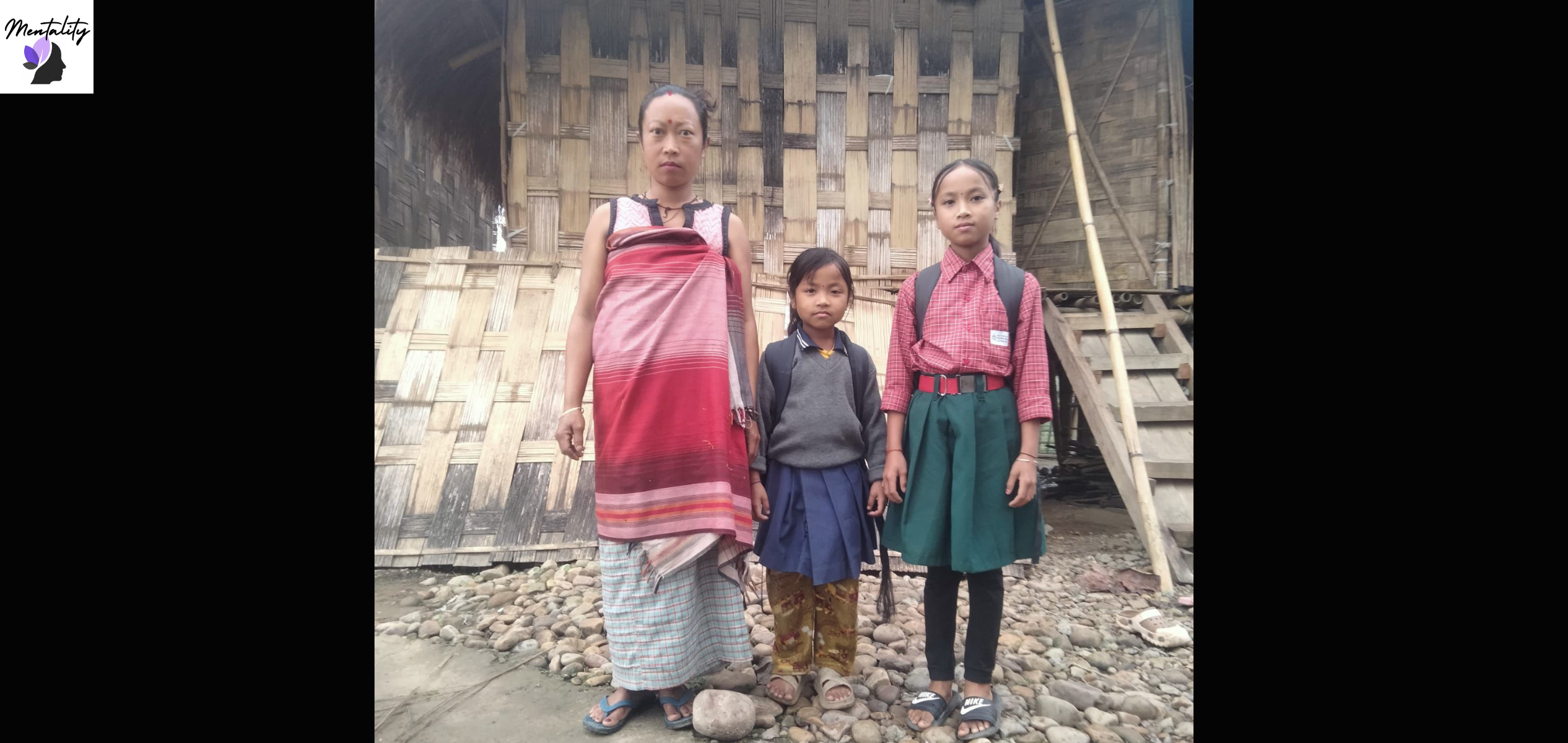
Baby Pegu (extreme right), along with her sister (centre) and mother, stands in front of their house (Image Credit: Rajib Pegu)
By Sayantani Deb
Of the 5.4 million climate migrants in India, 2.5 million were in Assam. Forced migration is harder on children, who end up suffering from headaches, nausea, and stomach aches without any identifiable organic cause.
On 29 June 2024, Baby Pegu’s small house in Sivaguri village of Dhemaji district, about 300 kilometres east of Guwahati, was washed away by the Siang river. She was only 9 years old then and remembered spending the night in knee-deep water.
Only the next morning did the district administration, along with the Assam State Disaster Management Authority, move Pegu’s family along with 300 others from their village to a relief camp in Jonai, approximately 85 kilometres away.
After six months in the relief camp, the family received some financial assistance from the government and relocated to Jelom, a few kilometres from the camp.
While the relocation brought hope to the elders, it left emotional scars on the children. Pegu lives with her parents and her 8-year-old sister. “Now Bao (father) and Yo (mother) spend most of their time outside, leaving me and Sarubani (her younger sister) alone,” she said.
Back in Sivaguri, her parents entrusted them to their neighbours, Tatos (grandfather), and Yayos (grandmother) when they stepped out for work. “Now everyone lives separately,” said Pegu, “thinking [about] this makes me very sad.”
Pegu and her sister were enrolled in a public school in Jelom. “I don’t like going to the new school,” she said because she doesn’t have friends there. “All my old friends are scattered across different villages.”
Although it has been two years since the flooding, the incident is etched in Baby’s mind, said Lakhyajyoti Doley, Principal of Jelom Lower Primary School, where Pegu is enrolled. “She struggles to concentrate, remains quiet, and doesn’t interact much.”
About 40% of Assam’s total area is flood-prone and every year, the administration readies itself to tackle the floods. However, waters of mighty rivers like the Brahmaputra and the Siang decide their own fate. In 2024, of the 5.4 million climate migrants in India, 2.5 million were in Assam. Comprehensive figures for 2025 are not available.
“Though children under the age of 5 years mimic the response of the elders, those above 5 years respond differently,” said Guwahati-based psychologist Dr Rijusmita Sarma. They are clingy, restless, and have sleep disorders, she said. “Many even give up on their identity and the things they relate to.”
Pegu said she still has nightmares about water entering the house and people screaming while running.
Parents’ predicament
Back in their village, Pegu’s father, Rajib Pegu grew sesame, mustard, and black gram in his 12 bighas (approximately 3.96 acres) of land.
After the floods took away their home, lands, and livelihoods, the main focus for the parents was to rebuild their lives. “We feel guilty about not being able to give enough time to our children,” said Rajib Pegu, “but we have no choice.”
Maneka Nath, 38, was widowed eight years ago when water levels in the Upper Siang region suddenly rose. After her husband’s death, the family moved across the Siang River from Kapou Sapori to Beya Sapori. Nayan Nath, Menaka’s youngest son, was only five years old back then. “I cried for days and begged my mother not to leave our old home,” he said.
Nath was forced to work as a construction worker in Beya Sapori village of Dhemaji district. “I don’t have the ability to understand what my children are going through,” she said. “We are just trying to survive.”
Geetashree Bortamuly, a Guwahati-based child psychologist, said that when children are forced to leave behind their belongings, familiar spaces, and even pets, it leads to separation anxiety. “When they lose everything suddenly, children lose their sense of motivation and emotional stability too,” she said.
Emotional toll on schools
Nayan Nath studies in Class VI at Bera Milan ME School and has had difficulty coping with studies. “Nayan could not understand his father’s death. He isolated himself, avoided school, and often sat alone talking to himself,” said Prema Chamuah, an assistant teacher at his school.
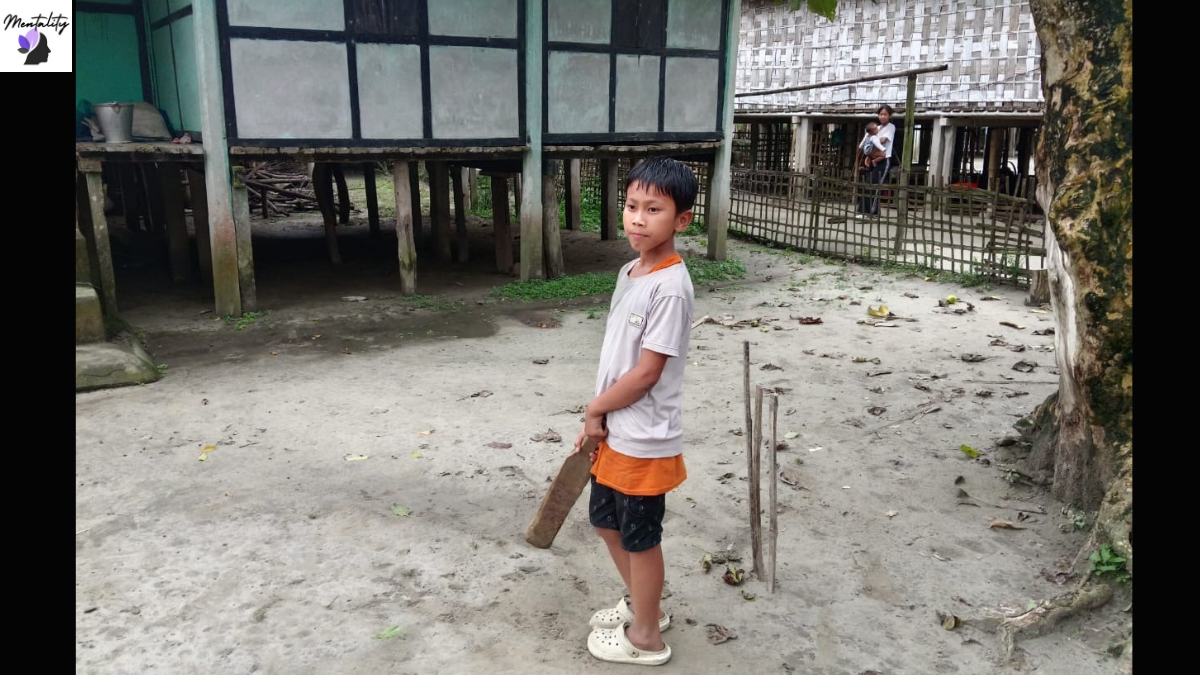
In the life of 10-year-old Nibir Pathori, the only constant has been displacement.
After Nibir’s mother died during his birth, he was brought up at his maternal uncle’s house at Major Chapori, where he studied for a short while before he moved to his father’s house in the flood-affected Missamora-II village, situated at the confluence of Subansiri-Brahmaputra rivers. “Every year, a portion of the home gets washed away due to erosion and during floods, and knee-deep water enters the house,” said Pankaj Pathori, Nibir’s father.
He now lives at a relative’s home in Ahatguri, Majuli. “I don’t like living like this,” he said. “I feel people pity me and have never been able to make a single friend.”
Pulak Jyoti Pathori, Nibir’s local guardian, said he understands Nibir’s anxiousness and loneliness and spends time playing football with him or taking him out to the market or namghars or satras [prayer houses that host community activities]. “I am doing my best to bring him out of emotional exhaustion,” he said.
Somatic symptoms are common in displaced children, said Dr Sarma. “They report headaches, nausea, and stomach aches without any identifiable organic cause often out of stress or anxiety,” she added.
Disaster-induced displacement not only disrupts a child’s home, but also disrupts their sense of safety, routine, and emotional well-being, said Dr Madhulika Jonathan, Chief of Field Office, UNICEF Assam & Northeast states. “Children experience fear, anxiety, grief and heightened protection risks when they are forced to leave familiar environments,” she said.
Rajib Pegu said that he hoped his children would feel better in their new setting. But that was not to be. He said he started following small routines that made them happy, like clicking their photos in uniforms before they left for school.
Baby Pegu and Nayan Nath have only recently begun to get better adjusted to their schools, their teachers said. “But, even today, a single drop of rain makes me anxious,” said Nayan Nath, “I fear I will lose someone again.”

Author: Sayantani Deb
An award-winning journalist based in Guwahati, Sayantani Deb takes keen interest in exploring and highlighting grassroots stories on social, cultural, and developmental issues from Northeast India.